
Choosing an AI automation company means finding a partner that understands your business processes, integrates with existing systems, and delivers measurable results.
The wrong provider can introduce unnecessary costs, unreliable workflows, and data security risks. McKinsey's 2026 State of AI survey reports that only 37% of respondents attribute any EBIT impact to AI, highlighting the gap between AI adoption and measurable financial results.
This guide covers 10 questions to ask an AI automation company, how to compare providers, and what to prepare before hiring one.
What Is an AI Automation Company?
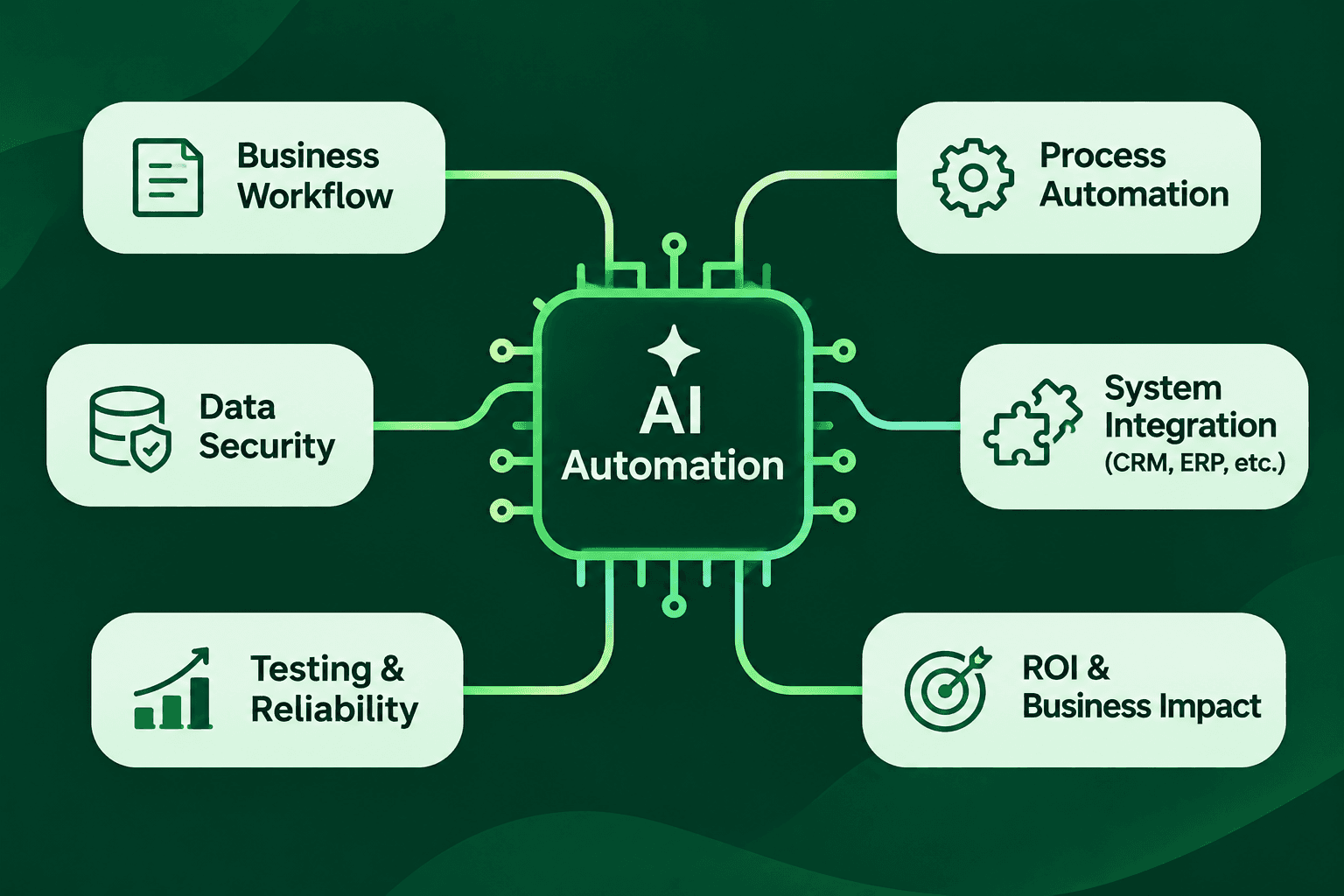
An AI automation company is a business that helps other businesses automate repetitive tasks, streamline workflows, and improve operations using artificial intelligence (AI).
Instead of relying on employees to manually complete every task, an AI automation company designs, builds, and integrates AI-powered solutions into a business's existing processes and software.
Common services include workflow automation, document processing, AI assistants, system integration, and custom AI development.
10 Questions to Ask an AI Automation Company Before Hiring
1. Have You Automated Workflows Similar to Ours?
Experience with AI technology does not automatically mean experience with your business processes.
Ask the provider:
- Can you demonstrate a similar project?
- What challenges occurred during implementation?
- What measurable results did the project achieve?
Look for: Relevant case studies explaining the original problem, implemented solution, and documented outcomes.
2. How Will You Decide Whether Our Process Needs AI?
A reliable provider should evaluate whether existing software, rule-based automation, or AI is the most suitable solution.
| Business task | Possible approach |
| Sending scheduled reminders | Rule-based automation |
| Moving website leads into a CRM | Standard integration |
| Classifying customer emails by meaning | AI-enabled automation |
| Extracting information from varied documents | AI document processing |
| Searching internal documents using natural language | AI assistant with approved data access |
Ask the provider: How will you evaluate our workflow, and which steps actually require AI?
Look for: A clear explanation of the recommended technology and why simpler alternatives may not be sufficient.
3. Can Your Solution Integrate With Our Existing Systems?
AI automation should work with the software your business already uses, including CRM, ERP, accounting, and communication platforms.
Ask the provider:
- Which systems can you integrate with?
- What integration methods will you use?
- What happens if a connected system becomes unavailable?
Look for: A documented integration plan covering data flow, dependencies, limitations, and failure handling.
4. How Do You Handle Data Security and Privacy?
AI workflows may process customer information, financial records, and confidential business documents.
The OWASP Top 10 for LLM Applications identifies risks such as prompt injection and sensitive information disclosure.
Ask the provider:
- Where will our data be processed and stored?
- Which employees and third-party providers can access it?
- What happens to our data when the contract ends?
Look for: Documented access controls, security procedures, data retention policies, and transparency about third-party services.
5. What Will the Project Cost?
Compare the total cost of ownership, not just the initial development quotation.
| Cost component | What it may include |
| Discovery and development | Process analysis, solution design, implementation |
| Integration | Connecting existing software |
| AI usage and infrastructure | Model/API charges, hosting |
| Testing and deployment | Validation, security checks |
| Maintenance | Monitoring, updates, troubleshooting |
Ask the provider: What are the one-time costs, recurring charges, and potential additional expenses as usage increases?
Look for: An itemized proposal with clear assumptions and exclusions.
6. What Is the Implementation Timeline?
An AI automation project typically moves through discovery, design, pilot development, testing, deployment, and monitoring.
Timelines depend on workflow complexity, integrations, data readiness, and internal approvals.
Ask the provider:
- When can we test a working pilot?
- What milestones and deliverables are planned?
- What responsibilities will our internal team have?
Look for: A realistic project plan with defined deliverables, dependencies, and approval stages.
7. How Will You Test Accuracy and Reliability?
AI can sometimes give incorrect answers that appear accurate. The NIST Generative AI Profile identifies this as a known risk.
For example, if AI cannot accurately read an invoice, it should flag it for human review instead of processing incorrect information.
Ask the provider:
- Will the solution be tested using representative business data?
- How will incorrect or uncertain outputs be handled?
- Can employees review or override important actions?
Look for: Defined acceptance criteria, exception handling, monitoring, and human oversight.
8. How Will We Measure ROI?
Before implementation, establish how much time and money the current workflow requires.
Useful metrics include processing time, manual effort, error rates, response time, and cost per transaction.
Illustrative example: A business processes 300 requests per month.
| Metric | Before automation | After automation |
| Manual time per request | 20 minutes | 5 minutes |
| Total monthly manual time | 100 hours | 25 hours |
This represents 75 hours of employee capacity freed per month.
At an assumed staff cost of ₹600 per hour, the capacity is valued at ₹45,000 monthly, before implementation and operating costs.
These figures are hypothetical. Freed capacity is not automatically a cash saving.
Ask the provider: Which KPIs will be measured, and how will the project costs and benefits be evaluated?
Look for: A documented baseline, measurable targets, and a method for reviewing outcomes after deployment.
9. Who Owns the Workflows, Data, and Deliverables?
Ownership arrangements can differ depending on whether the solution uses custom code, third-party platforms, or licensed software.
Ask the provider:
- Who owns the custom code, workflows, and documentation?
- Who controls the software accounts and access credentials?
- Can another provider maintain the solution if we switch vendors?
Look for: Clear contractual terms covering ownership, licensing, access, and transition support.
10. What Support Will You Provide After Launch?
Automation workflows require maintenance as business processes, software integrations, and AI models change.
Ask the provider:
- Who monitors the solution and resolves incidents?
- What support response times are agreed upon?
- Will our employees receive training and documentation?
Look for: Defined support responsibilities, escalation procedures, maintenance arrangements, and knowledge transfer.
How to Compare AI Automation Companies
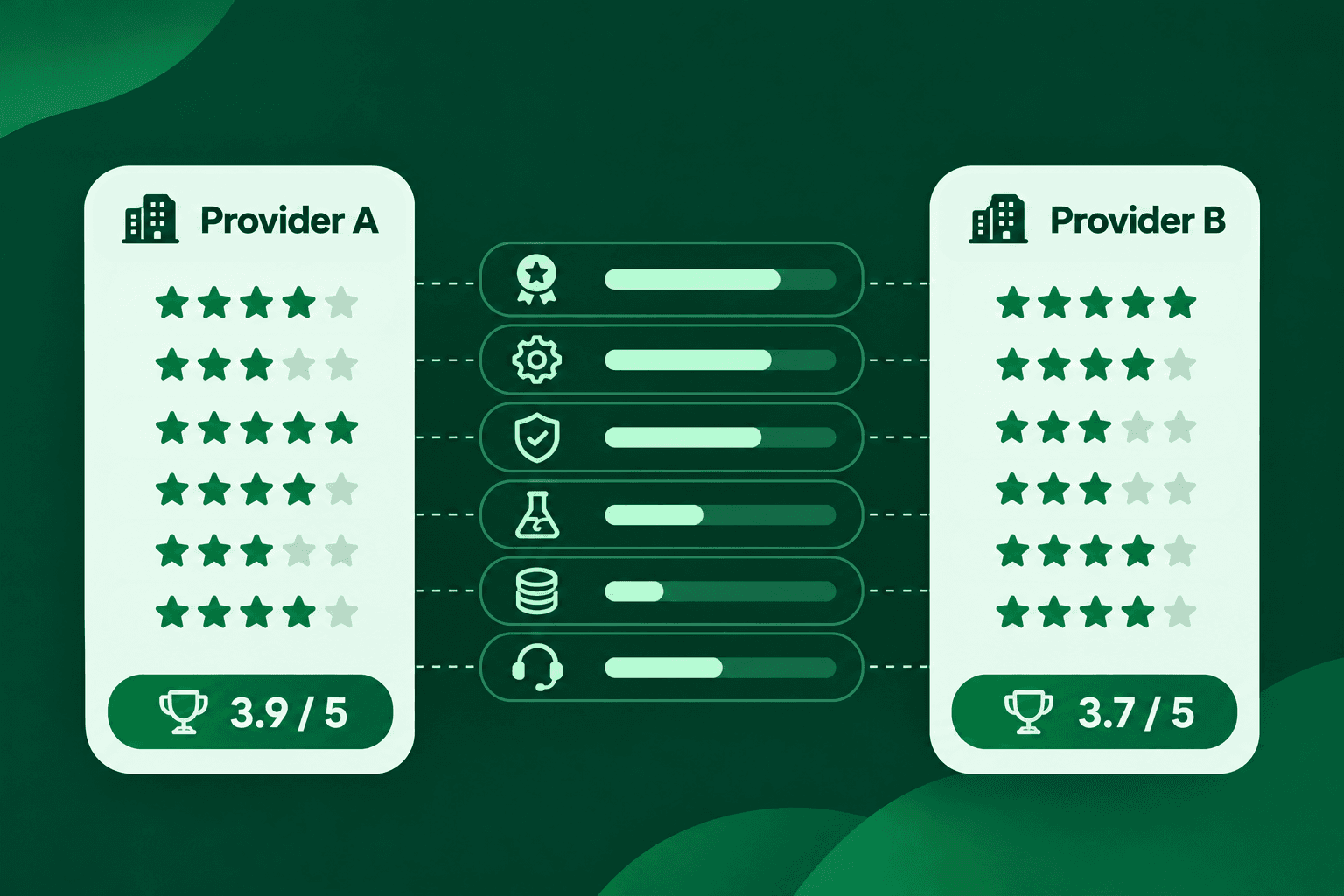
After evaluating providers using the ten questions, compare them using a consistent scoring method.
The following weights are suggested starting points, not an industry standard.
| Evaluation criterion | Suggested weight |
| Relevant workflow experience | 20% |
| Technical and integration capability | 20% |
| Security and data governance | 20% |
| Testing and reliability | 15% |
| Pricing transparency | 10% |
| Support and maintenance | 15% |
| Total | 100% |
How to Score Providers
Rate each provider from 1 (poor) to 5 (excellent), multiply each rating by its assigned weight, and add the weighted scores.
For example:
| Criterion | Weight | Provider A | Provider B |
| Workflow experience | 20% | 4 | 5 |
| Integration capability | 20% | 3 | 4 |
| Security | 20% | 5 | 3 |
| Testing | 15% | 4 | 3 |
| Pricing transparency | 10% | 3 | 4 |
| Support | 15% | 4 | 3 |
| Weighted total | 100% | 3.90/5 | 3.70/5 |
Hypothetical example.
Provider A scores higher overall, despite Provider B having stronger workflow experience.
However, a high total should not override a serious weakness in a critical area such as security.
What Are the Red Flags When Hiring an AI Automation Company?
Be cautious if a provider:
- Guarantees financial results before assessing your workflow.
- Cannot provide relevant implementation evidence.
- Avoids documenting security measures or total costs.
- Offers an impressive demonstration without a realistic deployment plan.
- Will not clarify ownership or transition arrangements.
These warning signs should be investigated before signing a contract.
How Falcon Reality Approaches AI Automation Projects
At Falcon Reality, we start by understanding the business process before deciding where AI fits.
Our projects illustrate different approaches:
- Howe Robinson Partners: AI-assisted Charter Party contract drafting reduced drafting time from approximately eight hours to four.
- CareUp demo automation: A website form and connected automation simplified demo account creation and follow-ups.
- CareUp analytics: Disconnected revenue information was consolidated into a dashboard for easier reporting.
These examples show why the solution should depend on the workflow. Sometimes AI is appropriate; other times, straightforward automation or integration is sufficient.
Conclusion: Choosing the Right AI Automation Partner
Choosing an AI automation company requires evaluating more than technical capability. The right provider should understand your workflow, integrate with existing systems, manage risks, and demonstrate measurable business value.
Use the ten questions and scoring framework to compare providers consistently, then begin with one clearly defined process.
Looking for an AI automation partner? Explore Falcon Reality's AI automation services or book a consultation to discuss your requirements.