
 Maritime

Introduction
Every vessel movement generates dozens of documents before cargo even begins moving. Bills of lading, certificates, customs paperwork, crew records, port clearances, invoices, and compliance documents pass through multiple teams, often with the same information typed repeatedly into different systems.
Maritime document automation uses AI to reduce this repetitive work by extracting, validating, and organizing information from documents. For maritime operators, this means faster document processing, better compliance, and more time for teams to focus on decisions rather than paperwork.
Why Maritime Documentation Is Still a Major Operational Challenge
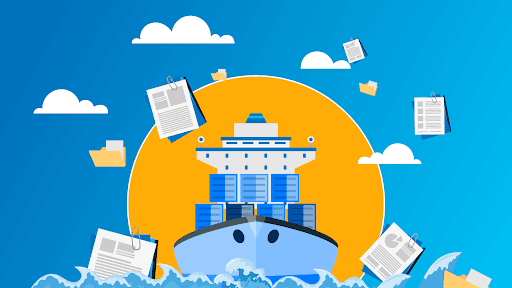
Maritime documentation is challenging because it is high-volume, repetitive, and often fragmented across multiple parties and systems. A single voyage can involve shipping lines, agents, terminals, port authorities, customs brokers, ship managers, and crew teams, all handling different formats and timelines.
The problem is compounded by document diversity. Teams may receive structured forms, scanned PDFs, handwritten notes, emails, and legacy files, all of which require review and validation before they can support an operational decision.
Errors are expensive in this environment. Missing fields, inconsistent identifiers, expired certificates, and delayed approvals can trigger rework, delay vessel clearance, or create compliance risk.
Where Maritime Operators Spend Most of Their Documentation Time
A large share of documentation time is spent on manual reading, data entry, and verification. Teams often retype information from shipping papers into systems, compare details across forms, and chase missing or inconsistent records.
Another major time sink is classification and retrieval. Finding the right version of a document, attaching it to the correct voyage or vessel, and ensuring it is stored in the right folder or workflow can take longer than the actual operational review.
The final time drain is exception handling. Even when most documents are standard, staff still need to handle mismatches, missing signatures, expired certificates, and format issues that prevent straight-through processing.
What Is Maritime Document Automation?
AI-powered document automation uses machine learning and natural language processing to extract, understand, validate, and route documents with minimal manual effort. In shipping, that means an AI system can identify a document type, pull out key fields, check them against expected rules, and send the file to the right person or system.
This is broader than basic OCR. OCR converts scanned text into machine-readable text, but AI document automation goes further by interpreting context, classifying document types, and flagging anomalies.
In maritime workflows, this can apply to bills of lading, port clearance papers, crew documents, certificates, and shipment records. The goal is not to remove human oversight, but to remove repetitive manual handling so humans focus on review, exceptions, and control.
Explore AI Document Automation in Maritime
AI document automation can support different maritime workflows, from extracting information from documents to validating records and managing specialized operational processes. Explore these areas in more detail:
-
OCR vs AI for Maritime Documents: Understand the difference between basic text extraction and intelligent document processing.
-
AI for Crew Documentation: See how AI can help manage crew certificates, records, expiry dates, and compliance documentation.
-
AI for Charter Party Automation: Explore how AI can support Charter Party drafting, clause retrieval, comparison, and review.
-
AI for Statement of Account Verification: Learn how AI can identify discrepancies and streamline SOA verification.
-
AI for Maritime Compliance: Learn how AI can automate compliance documentation, process regulatory updates, track certificates and deadlines, and make audit evidence easier to retrieve.
Common Maritime Documents Suitable for AI
- Bills of Lading
- Charter Parties
- SOA
- Noon Reports
- Crew Certificates
- Port Clearance Documents
- Cargo Manifests
- Invoices
- Purchase Orders
- Customs Documents
6 Ways Maritime Document Automation Reduces Manual Work
Automatic document classification. AI can identify whether a file is a bill of lading, certificate, clearance document, or crew record, which reduces sorting time and manual tagging.
Automatic document classification. AI can identify whether a file is a bill of lading, certificate, clearance document, or crew record, which reduces sorting time and manual tagging.
-
Fast data extraction: AI can pull out structured fields such as vessel name, IMO number, cargo details, certificate expiry dates, and reference numbers from both digital and scanned documents.
-
Validation against business rules: AI can compare extracted information with expected templates, compliance standards, or internal master data to flag missing or inconsistent fields early.
-
Exception detection: Instead of making teams review every file line by line, AI can highlight only the documents or fields that need attention, which cuts review time and rework.
-
Search and retrieval: AI-supported indexing makes it easier to find documents by vessel, voyage, cargo, date, or document type, which reduces time lost in manual file searches.
-
Workflow routing and integration: Once a document is classified and validated, it can be routed automatically to the right team or connected system, reducing back-and-forth between operations, compliance, and finance.
The table below shows how maritime documentation processes compare with and without AI, emphasizing the impact on document handling, compliance, and workflow efficiency.
| Aspect | Without AI | With AI |
|---|---|---|
| Document search | The crew manually searches folders, PDFs, and files, which is slow during operations or inspections. | Users can ask questions in natural language and retrieve the right document or section instantly. |
| Classification | Documents are often stored across different folders or formats with limited standardization. | AI can read, classify, and organize large sets of documents automatically. |
| Key data extraction | Expiry dates, inspection results, and compliance details are checked manually. | AI can extract key data points such as expiry dates, equipment references, and regulatory requirements. |
| Compliance tracking | Teams manually monitor renewals and missing records, which increases the chance of error. | AI can flag documents that need renewal and identify missing compliance records across a fleet. |
| Inspection readiness | Preparing for Port State Control or audits can be stressful and time-consuming. | Documentation stays continuously organized, making inspections faster and less disruptive. |
| Human error risk | Dense manuals and manual cross-referencing raise the risk of missed clauses or misinterpretation. | Automation reduces search errors and helps crews get to the correct information faster. |
| Crew workload | Crews spend substantial time locating, cross-checking, and updating documents. | Routine documentation tasks are automated, freeing time for operations. |
| Operational visibility | Document status can be fragmented across systems, folders, or vessels. | AI gives centralized visibility across documents, renewals, and compliance gaps. |
| Decision support | Documents mainly serve as static records. | AI can support operational decisions by linking documents to compliance and risk insights. |
Real-World Examples of Maritime Document
1. Port of Rotterdam Authority: AI-Powered Document
The Port of Rotterdam Authority implemented AI-based document processing to handle large volumes of invoices and tonnage certificates received from shipping agencies.
Using AI document extraction and classification technology, the port authority achieved:
- More than 90% extraction accuracy after processing only ten document samples
- A 70.7% reduction in manual document processing effort
- Approximately 810 working days saved annually through automation
The project also enabled faster onboarding of new document formats without creating new templates for every supplier, significantly reducing administrative overhead.
2. NYK Group: Creating a Single Source of Truth
NYK Group implemented integrated vessel monitoring systems to centralize data such as vessel position, weather, and engine information. This reduced the need for teams to enter the same information into multiple systems and improved the consistency of operational and environmental records.
Results
- Less manual data entry and duplication.
- More accurate and consistent voyage records.
- Faster operational decisions and fewer follow-up documentation tasks.
- Better support for AI-driven planning and remote diagnostics.
Key Takeaway: By centralizing operational data, NYK reduced repetitive administrative work and improved record consistency across its fleet.
3. AI-Powered Charter Party Automation
A leading global shipbroking company implemented an AI-powered Charter Party (CP) automation system to streamline its highly manual contract drafting process. Previously, drafting a single Charter Party took 6 to 8 hours, with teams repeatedly copying clauses, reviewing historical contracts, and re-entering similar information.
Results
- Reduced Charter Party drafting time by up to 50%, from 6-8 hours to 3-4 hours.
- Eliminated much of the repetitive manual work involved in creating similar contracts.
- Improved consistency through standardized templates and clauses.
- Allowed chartering teams to spend more time on negotiations and commercial decisions instead of paperwork.
Key Takeaway: The project showed that AI can significantly reduce documentation time in chartering workflows while keeping final decisions and approvals firmly in the hands of maritime professionals.
4. Heung-A Shipping: AI-Based Regulatory Document Management
Heung-A Shipping implemented an AI-powered document management system to improve the handling of regulatory and compliance documents.
Using AI to automate document parsing, version control, and compliance updates, the company achieved:
- Faster processing of regulatory documents
- Reduced manual effort in document management
- Improved compliance through automated version control
- More efficient handling of documentation across teams
5. NAD Logistics: AI-Powered Shipment Document Automation
NAD Logistics implemented an AI-based document automation solution to process shipment paperwork and invoices received through email.
Using AI to extract documents, validate completeness, and verify shipment information, the company achieved:
- Invoice turnaround time reduced from 2.11 days to 0.47 days
- Saved 90 to 120 minutes of manual work every day
- Reduced manual review of shipment documentation
- Faster and more accurate document processing
Benefits of Maritime Document Automation Beyond Time Savings
The obvious benefit is faster processing, but the broader value is operational resilience. When document handling is automated, teams can reduce errors, improve traceability, and cut the risk of delayed approvals or missing records.
AI also improves compliance consistency. Automated checks can flag expired certificates, mismatched details, or missing files before they create downstream problems, which is especially important in regulated maritime workflows.
There is also a productivity benefit. Less time spent on routine document handling means staff can focus on exceptions, supplier coordination, port coordination, and service recovery.
Challenges Maritime Companies Face When Implementing AI
The biggest challenge is not the AI model itself, but the quality and variability of the documents. Maritime paperwork comes in many formats, scans, templates, and languages, which can make extraction and validation harder than in more standardized business processes.
Integration is another issue. AI only saves time if it connects cleanly with existing ERP, port, vessel, crew, or document management systems; otherwise, staff end up moving data between tools manually.
Change management matters too. Teams need trust in the system, clear exception workflows, and human oversight for edge cases. Without that, automation can be adopted partially, which limits the return on investment.
How to Start Automating Maritime Documentation
Start with one high-volume, repetitive document flow where delays are visible and measurable. Crew documents, bills of lading, certificates, or port clearance packets are usually strong candidates because they combine repetition with compliance risk.
Next, map the current process and measure baseline time spent on intake, extraction, validation, filing, and exception handling. That gives you a way to quantify improvement after automation is introduced.
Then pilot the system on a limited scope, such as one vessel class, one port pair, or one document family. The best pilots are the ones that can prove fewer manual touches, faster turnaround, and cleaner records before you expand.
The Future of Maritime Documentation Is AI-Assisted
The future is not fully autonomous paperwork without oversight. It is AI-assisted documentation, where systems handle repetitive reading, sorting, extraction, and checking while humans manage the exceptions and approvals.
As maritime operations become more digitized, the value of document intelligence will increase because workflows will depend more on speed, traceability, and interoperability across systems and stakeholders. The companies that win will be the ones that treat documentation automation as an operational capability, not just an IT project.
Conclusion
The companies gaining the most from AI are not replacing documentation teams. They are removing repetitive work so experienced professionals can focus on exceptions, compliance, and operational decisions. As document volumes continue to grow, AI-assisted documentation is becoming a competitive capability rather than just another technology project.