
 Maritime

Crew documentation shouldn't be the hardest part of managing a crew
A crew change scheduled for tomorrow suddenly gets delayed because one medical certificate expired three days ago. Operations scramble through emails, shared folders, and spreadsheets trying to locate the latest document. Sound familiar?
For many crewing departments, documentation isn't just paperwork. It directly affects vessel schedules, compliance, and operational efficiency.
This is where AI is beginning to transform maritime crew management.
Why Crew Documentation Is a Challenge
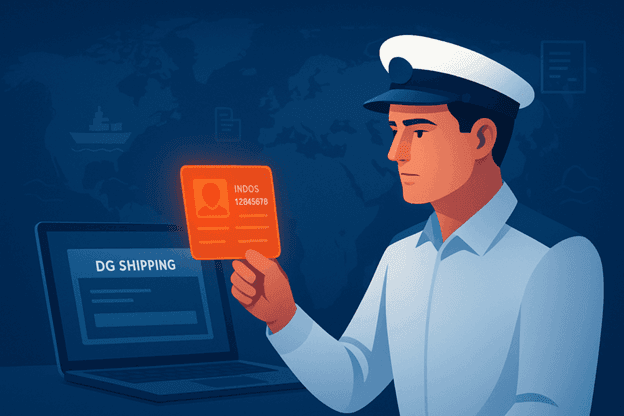
Common challenges include:
- Documents stored across emails, spreadsheets, shared drives, and paper files
- Manual tracking of expiry dates
- Time spent entering information into crew management systems
- Last-minute document verification before crew changes
- Multiple stakeholders reviewing the same documents
The complexity of managing crew documentation continues to increase as regulatory requirements become more digital. The IMO is expanding standardized electronic reporting for seafarer information, including STCW certificates, to improve interoperability between ships, ports, and maritime authorities.
What Documents Are Involved?
Crew administration requires managing a wide range of documents, including:
- Passports
- Seafarer's Identification Documents (SID)
- Continuous Discharge Certificates (CDC)
- Certificates of Competency (CoC)
- STCW certificates
- Flag State endorsements
- Medical fitness certificates
- Visas
- Employment contracts
- Training records
- Vaccination certificates
- Security clearances
These documents must comply with international regulations such as the STCW Convention, Maritime Labour Convention (MLC, 2006), and flag-state requirements.
Why Manual Crew Documentation Fails
Managing crew documents manually becomes more difficult as fleets grow and regulations become more complex. Common challenges include:
- Documents are stored in different places, such as emails, spreadsheets, shared drives, and paper files
- Tracking expiry dates manually increases the risk of missing important renewals
- Repeated data entry across multiple systems takes time and can lead to errors
- Finding the latest version of a document can be difficult when multiple copies exist
- Last-minute document verification before crew changes creates unnecessary pressure
- Preparing for audits often requires reviewing hundreds of documents manually
- Limited visibility makes it difficult to monitor the compliance status of all crew members across the fleet
As the maritime industry moves towards digital reporting through initiatives like the IMO Maritime Single Window, managing crew documentation manually is becoming increasingly difficult for shipping companies.
How AI Works in Crew Documentation
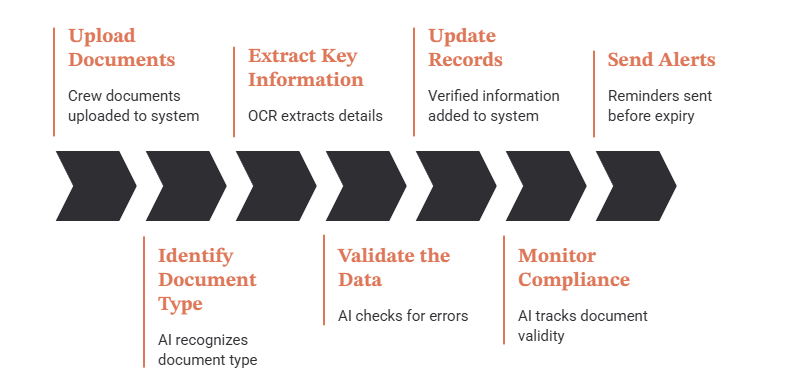
AI Technologies Used for Crew Documentation
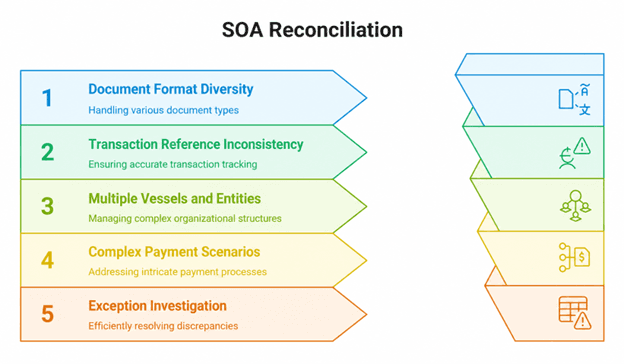
- Optical Character Recognition (OCR): Converts scanned certificates and documents into searchable digital text.
- Machine Learning (ML): Learns to recognize different document formats and improve extraction accuracy over time.
- Natural Language Processing (NLP): Understands document content and helps users search records using simple language.
- Document Classification: Automatically identifies whether a file is a passport, STCW certificate, medical certificate, visa, or another document.
- Rule-Based Validation: Checks whether mandatory documents are present and whether certificates meet compliance requirements.
Together, these technologies reduce manual data entry and make document management faster and more consistent. Unlike basic OCR, AI can help interpret and structure information from different document formats. Learn more about the difference between OCR and AI for maritime documents.
Benefits of AI-Powered Crew Documentation
AI helps crewing teams spend less time on administrative work and more time managing crew operations. Instead of reviewing every document manually, AI can process thousands of records consistently and identify potential compliance issues early.
AI can help organizations:
- Extract data from crew documents automatically
- Classify different document types
- Detect missing or incomplete certificates
- Monitor expiry dates continuously
- Send automatic renewal reminders
- Update crew management systems with extracted information
- Create centralized compliance dashboards
- Support faster audit preparation
Digital documentation is already becoming standard across shipping. DNV alone issues more than 130,000 electronic certificates every year, helping reduce paperwork and making certificates easier to store, verify, and share securely.
AI vs Manual Crew Documentation
| Manual Crew Documentation | AI-Powered Crew Documentation |
|---|---|
| Information entered manually | Information extracted automatically |
| Expiry dates tracked in spreadsheets | Continuous expiry monitoring with alerts |
| Documents searched across emails and folders | Centralized, searchable digital records |
| Manual document verification | Automatic document classification and validation |
| Time-consuming audit preparation | Faster audit readiness with organized records |
| Higher risk of missed renewals | Early notifications before certificates expire |
Improving Maritime Compliance with AI
Compliance is one of the biggest reasons shipping companies invest in better documentation processes.
International regulations require operators to maintain accurate records demonstrating that crew members hold valid qualifications and certifications.
AI helps strengthen compliance by:
- Continuously monitoring document validity
- Sending automatic renewal reminders
- Highlighting missing certifications before crew assignments
- Creating centralized audit trails
- Providing real-time compliance dashboards
Instead of discovering a problem during a Port State Control inspection or just before crew mobilization, operators can identify issues weeks in advance.
This proactive approach reduces operational disruption while improving audit readiness.
Operational Benefits for Crewing Teams
The biggest advantage of AI is not simply faster document processing.
It allows crewing teams to spend less time on administrative work and more time managing people.
Organizations adopting AI-powered documentation workflows often experience benefits such as:
- Faster crew onboarding
- Reduced manual data entry
- Improved document accuracy
- Better visibility across the fleet
- Quicker preparation for audits
- Easier collaboration between ship and shore teams
As document volumes increase, these efficiencies become increasingly valuable for maintaining smooth operations.
Best Practices for AI Adoption
Implementing AI is not just about choosing the right software.
Organizations also need:
- Standardized document formats where possible
- Clean and structured historical data
- Integration with existing crew management systems
- Human validation for critical compliance decisions
- Clear governance over document ownership and workflows
AI performs best when it supports well-defined processes rather than trying to compensate for inconsistent ones.
The Future of AI in Maritime Crew Administration
The next generation of maritime AI will move beyond document storage toward intelligent crew administration.
Instead of simply locating files, AI systems will increasingly:
- Answer questions about crew compliance in natural language
- Predict upcoming documentation risks
- Recommend actions before certificates expire
- Automatically prepare crew documentation for audits
- Integrate documentation with crew scheduling and workforce planning
The goal is not to eliminate human oversight but to reduce administrative complexity and provide faster, more reliable access to critical information.
Why Digital Crew Documentation Is Becoming Essential
The industry is not adopting AI simply because it is new. Regulatory requirements are becoming increasingly digital, while fleet sizes and documentation volumes continue to grow.
- IMO now promotes electronic submission of ship and crew information through Maritime Single Window initiatives.
- DNV issues over 130,000 electronic certificates every year.
- Digital certificates have already been successfully used in approximately 1,000 Port State Control inspections.
Crew documentation is just one area where these workflows can be applied. Explore how maritime operators can reduce documentation time with AI across other document-heavy processes.
Conclusion
Crew documentation has always been a critical part of maritime operations, but the growing volume of certifications, regulations, and compliance requirements has made manual processes increasingly difficult to sustain.
AI offers a practical way to automate document processing, improve data accuracy, and reduce compliance risks while allowing crewing teams to focus on higher-value work. As the maritime industry continues its digital transformation, AI-powered crew documentation is likely to become a standard capability rather than a competitive advantage.