
 Maritime

Introduction
The biggest obstacle to Maritime AI isn't technology. It's the industry's memory of failed technology projects.
If AI can automate documentation, optimize operations, and improve decision-making, why do many shipping companies remain skeptical of AI vendors?
In this blog, we'll explore why Maritime AI projects fail, what successful deployments do differently, and a practical framework for building AI solutions that deliver measurable operational value.
AI in the maritime industry is gaining momentum , with 81% of respondents already running AI pilots or small-scale projects and 82% believing AI can improve operational efficiency. Yet only 11% have formal AI governance policies, while 37% have personally witnessed an AI project fail. The result isn't just wasted investment. Failed initiatives erode trust, slow digital transformation, and make organizations more hesitant to adopt AI solutions that could deliver real operational value. (Source: Thetius & Marcura, Beyond the Hype: What the Maritime Industry Really Thinks About AI, 2025.)
Why Most Maritime AI Projects Fail
Vendors Lack Maritime Context
Many AI vendors are experts in AI, not maritime. This creates avoidable friction from day one:
- Weeks spent explaining basic maritime terminology and workflows.
- AI models built on assumptions instead of operational reality.
- Generic solutions that don't fit existing processes.
- Low trust and poor adoption by end users.
AI Is Introduced Before The Problem Is Clearly Defined
Many Maritime AI projects start with "Let's use AI" instead of "Let's solve this problem." The result is unclear objectives, poor ROI, and solutions looking for a problem. As RAND highlights in its Improving the Success of AI Projects in the Public Sector report, projects are far more likely to fail when organizations focus on the technology before clearly defining the problem they're trying to solve.
Generic AI Doesn't Fit Existing Workflows
Maritime operations involve constant coordination between ships, ports, agents, regulators, and documents. Generic AI tools rarely account for these interconnected workflows, creating friction instead of efficiency. As the World Bank notes, digitalization succeeds when systems streamline data exchange across the maritime ecosystem, not when they operate in isolation.
End Users Don't Trust The Output
AI can simplify everyday maritime operations, but only if people actually use it. When end users aren't involved in the process or don't trust the output, they continue verifying everything manually or fall back to existing workflows. The result is an expensive AI tool that changes nothing.
No Internal Champion to Drive the Project
Many AI projects slow down because vendors lack a clear internal point of contact. Without someone who understands the business, aligns stakeholders, and provides timely decisions, projects get delayed by constant back-and-forth and shifting requirements. A dedicated internal champion keeps the project moving and ensures the solution solves real operational problems.
Lessons We've Learned From Building Maritime AI
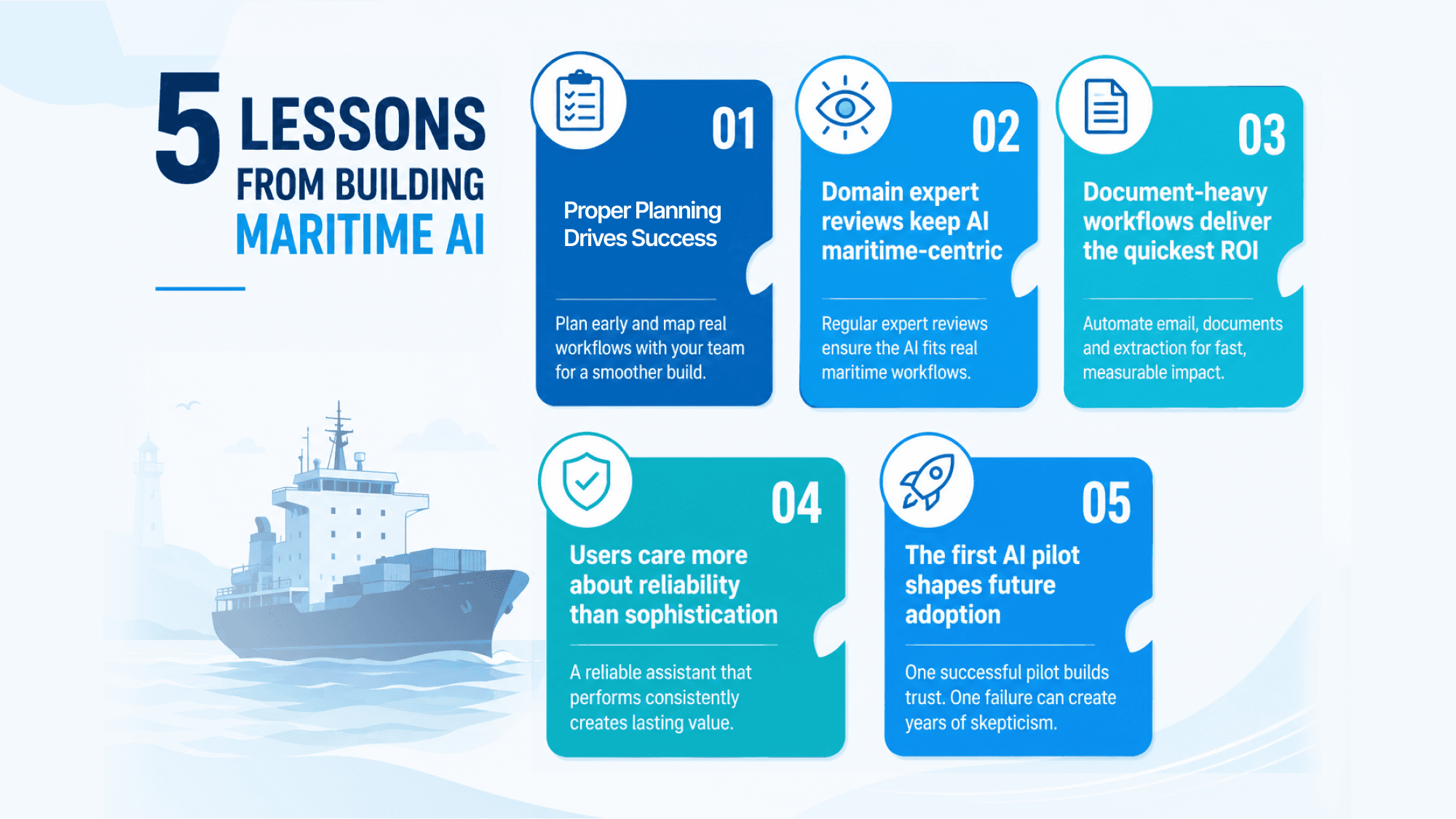
While every implementation is different, several recurring patterns consistently emerge across Maritime AI projects.
1. Proper planning upfront makes implementation smoother
Proper planning at the beginning, and mapping out all the workflows by talking to the real team who do the manual work makes the development cycle very smooth.
2. Domain expert reviews keep AI maritime-centric
Regular reviews by maritime domain experts throughout development help validate assumptions, capture operational nuances, and ensure the AI solution aligns with real-world maritime workflows.
3. Document-heavy workflows usually deliver the quickest ROI.
Automating email processing, document classification and information extraction often creates measurable impact faster than complex predictive models.
4. Users care more about reliability than sophistication.
A consistently dependable assistant is more valuable than an advanced system that behaves unpredictably.
5. The first AI pilot shapes future adoption.
One successful implementation builds trust across the organization. One failed initiative can create skepticism that lasts for years.
What Successful Maritime AI Deployments Do Differently
Start with One Operational Bottleneck
Successful AI projects don't begin with "Where can we use AI?" They begin with "What is our biggest operational bottleneck?" Starting with a clearly defined problem makes outcomes measurable and keeps the project focused.
Embed Maritime Expertise Early
AI expertise alone isn't enough. Domain experts should be involved from the start to provide operational context, validate assumptions, and ensure the solution reflects real maritime workflows rather than generic business logic.
Design Around Existing Workflows
Generic AI often fails because it doesn't reflect how maritime operations actually work. Successful AI deployments are built around existing workflows, integrating seamlessly with day-to-day processes instead of forcing teams to adapt to generic systems.
Earn User Trust Before Scaling
Early user involvement and training build confidence and improve adoption. When people understand how AI works and why it's being introduced, they're more likely to trust it and use it effectively.
Create Clear Project Ownership
Every successful AI project needs an internal champion who can provide business context, align stakeholders, and make timely decisions. Clear ownership keeps projects moving and prevents delays caused by internal ambiguity.
Run Smaller, Value-Anchored AI Pilots
Instead of attempting large-scale transformation, successful organizations start with focused pilots, measure business impact, and expand gradually. Small wins build trust and create a stronger foundation for long-term AI adoption.
Expand Only After Measurable Wins
Successful organizations always measure operational outcomes before scaling AI initiatives. Rather than expanding based on technical performance alone, they validate real business impact through metrics like time saved, reduced errors, and improved efficiency before rolling out the solution more broadly.
Common Questions Organizations Should Ask Before Investing in Maritime AI
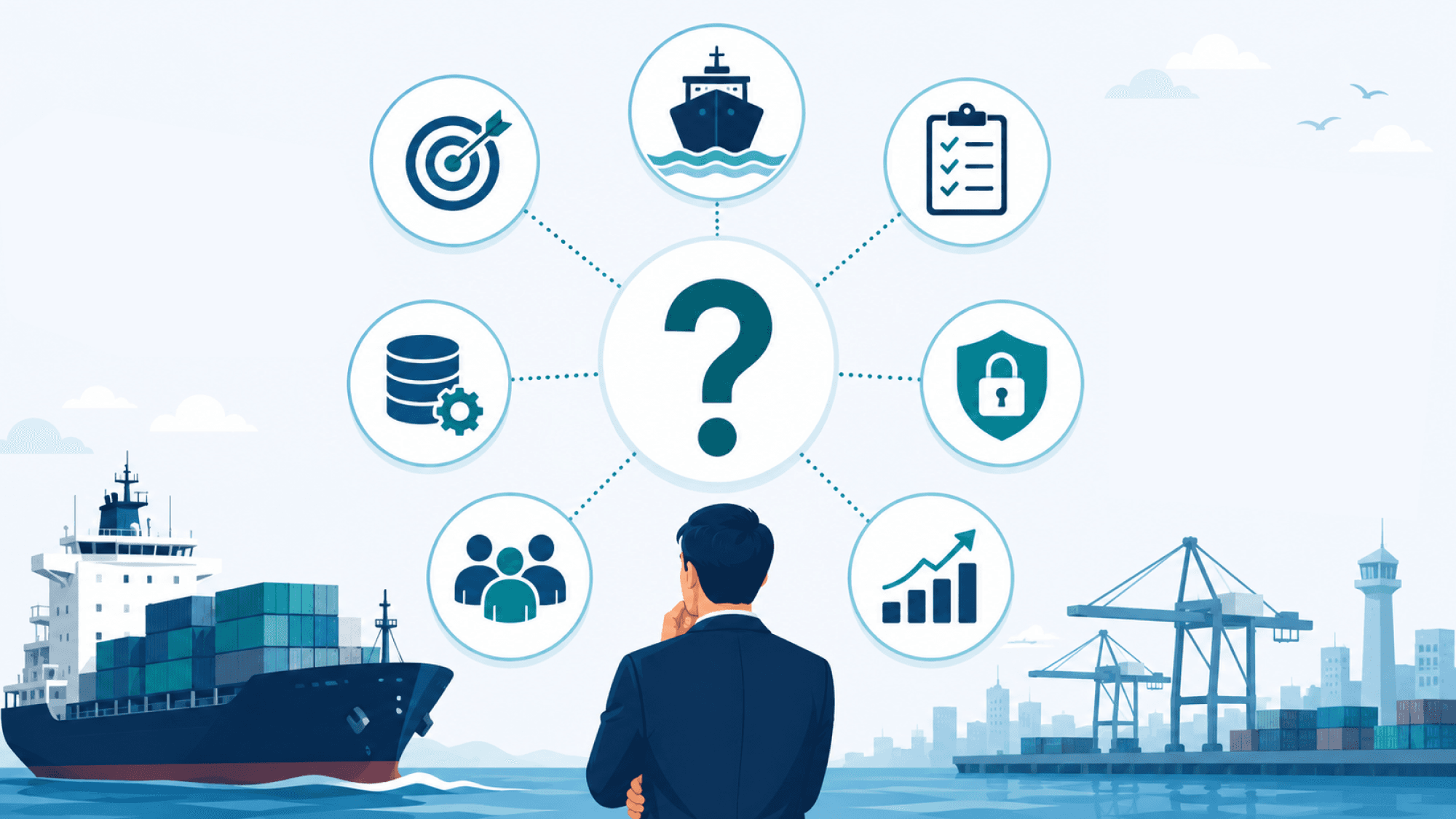
Before investing in any AI solution, shipping companies should take a step back and evaluate whether they're solving the right problem. Asking the right questions early can prevent costly mistakes and significantly improve the chances of a successful deployment.
What operational problem are we trying to solve?
AI should address a clearly defined business challenge, not be implemented simply because it's the latest technology.
Will this solution fit our existing workflows?
The best AI solutions integrate seamlessly into maritime operations instead of forcing teams to change proven processes.
Do we have the right data and domain expertise?
High-quality data and maritime knowledge are essential for building AI systems that deliver reliable and practical results.
Who will own the project internally?
A dedicated internal champion helps align stakeholders, make timely decisions, and keep the implementation on track.
How will we measure success?
Define measurable outcomes such as reduced processing times, fewer manual tasks, lower error rates, or improved operational efficiency before the project begins.
Why Our Perspective Is Different
Falcon Reality approaches AI differently by combining technical expertise with operational maritime experience. Founder Aanshul Sharma spent four years as a Deck Officer, allowing projects to begin with an understanding of maritime operations rather than learning them during implementation. This practical context helps reduce discovery time and keeps AI development focused on operational value.
Conclusion
Maritime AI has the potential to streamline operations, reduce manual effort, and improve decision-making, but technology alone does not guarantee success. The projects that deliver lasting value are those built around clearly defined business problems, informed by maritime expertise, and supported by the people who use them every day.
Rather than pursuing AI for its own sake, shipping companies should focus on measurable operational outcomes, strong internal ownership, and gradual, value-driven implementation. When approached as a business initiative rather than a technology experiment, AI can become a practical tool for improving efficiency and driving long-term digital transformation across the maritime industry.