
 Maritime

Why Businesses Are Investing in Maritime AI Companies
The maritime industry is under increasing pressure to improve efficiency, reduce costs, and manage growing volumes of operational data. From vessel reporting and fleet monitoring to procurement and compliance, many critical workflows still rely on manual processes.
This shift is driving rapid investment in AI. According to Lloyd's Register, the maritime AI market grew from USD 1.47 billion in 2023 to USD 4.13 billion in 2024, while the number of active maritime AI organizations increased from 276 to 420.
Maritime AI companies help shipping organizations automate repetitive tasks, improve decision-making, and gain better visibility across operations. Whether the goal is reducing paperwork, optimizing voyages, or improving fleet performance, choosing the right AI partner can have a significant impact on long-term operational success.
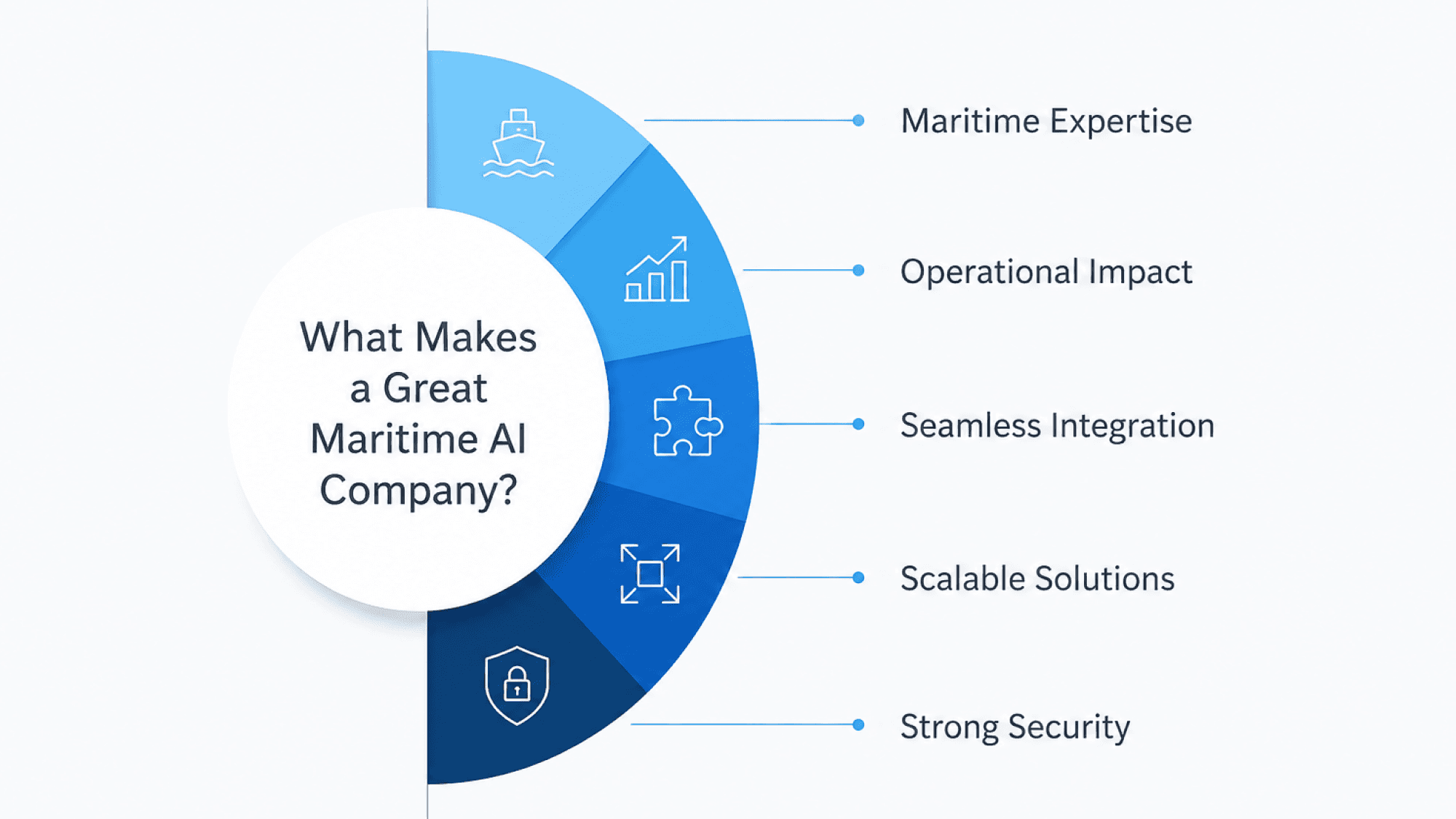
What Makes a Great Maritime AI Company?
Not every company offering AI understands the realities of maritime operations.
Some specialize in autonomous navigation, while others focus on fleet intelligence, document automation, predictive maintenance, or maritime compliance. The right partner should combine AI expertise with a deep understanding of shipping workflows and operational challenges.
When evaluating maritime AI companies, look for the following qualities:
Maritime Domain Expertise
Experience working with ship owners, ship managers, ports, or logistics companies ensures solutions are built around real operational challenges rather than generic AI applications.
Proven Operational Impact
The strongest AI solutions deliver measurable improvements, such as reducing manual work, improving fleet visibility, lowering fuel consumption, or accelerating decision-making.
Integration with Existing Maritime Systems
AI should complement existing PMS, ERP, vessel reporting, and operational software rather than requiring organizations to replace established systems.
Scalable AI Implementation
Successful projects move beyond pilots and are designed to scale across fleets, departments, or multiple operational processes.
Security and Data Governance
Given the sensitive nature of operational and commercial shipping data, enterprise-grade security and responsible AI practices remain essential.
Types of Maritime AI Solutions Offered by Leading Companies
Maritime AI companies do not all solve the same problems. Some build specialized products for a single workflow, while others provide broader platforms that improve vessel operations, safety, compliance, and commercial decision-making.
Most providers fall into one of these categories:
-
Vessel Performance & Fleet Intelligence: Real-time operational analytics, voyage insights, emissions monitoring, and fuel-efficiency optimization.
-
Voyage Optimization & Fuel Efficiency: Route planning, weather-aware routing, ETA prediction, and fuel optimization.
-
Maritime Safety & Computer Vision: Bridge lookout support, collision avoidance, object detection, and situational awareness.
-
Predictive Maintenance: Condition monitoring, anomaly detection, fault prediction, and maintenance planning.
-
Compliance & Maritime Intelligence: Risk screening, sanctions and trade intelligence, document intelligence, and regulatory workflow support.
-
Autonomous Navigation & Robotics: Autonomous or remotely operated vessels, inspection robots, drones, and marine robotics.
-
Workflow Automation & AI Implementation: Email, document, chartering, crew, finance, and commercial workflow automation for shipping teams.
Top Maritime AI Companies in 2026
Falcon Reality helps maritime companies identify, build, and implement AI solutions that automate operational and commercial workflows. Rather than offering a single software product, it focuses on solving workflow bottlenecks with custom AI systems.
-
Best For: Shipping companies looking to automate repetitive operational processes and implement AI across multiple business functions.
-
Key Strength: Combines maritime domain expertise with custom AI implementation, helping organizations move from AI strategy to deployment.
-
Typical Solutions: AI agents, Fleet Intelligence, document processing, email automation, workflow automation, CP automations etc.
-
Credibility: Falcon Reality has worked with leading maritime organizations, including ISF and Howe Robinson, helping shipping businesses identify and implement practical AI solutions for real operational challenges.
-
Consideration: Better suited for organizations seeking tailored AI implementation than those looking for a ready-made software platform.
Orca AI develops AI-powered navigation systems that enhance bridge situational awareness, helping crews navigate more safely while reducing the risk of collisions.
-
Best For: Shipowners and fleet operators looking to improve navigational safety and reduce collision risks.
-
Key Strength: Computer vision and AI-powered situational awareness that assists bridge teams during navigation.
-
Typical Solutions: AI navigation assistance, collision avoidance, lookout automation, voyage analytics, bridge decision support, and fleet performance insights.
-
Consideration: Primarily enhances bridge operations and navigation, not broader commercial or back-office workflows.
Kongsberg Maritime is a global marine technology company delivering advanced automation, autonomous shipping, digital vessel systems, and integrated bridge solutions.
-
Best For: Shipowners, offshore operators, naval organizations, and shipyards implementing advanced digitalization and autonomous technologies.
-
Key Strength: Industry-leading portfolio combining vessel automation, autonomy, propulsion, and digital ship systems.
-
Typical Solutions: Autonomous vessel technology, integrated bridge systems, digital twins, vessel automation, dynamic positioning, and fleet performance platforms.
-
Consideration: Enterprise-grade solutions often involve significant investment and are typically deployed on larger, more complex fleets.
Windward provides maritime intelligence powered by AI, satellite imagery, and AIS data to help organizations improve compliance, manage risk, and gain greater visibility into global shipping activities.
-
Best For: Chartering teams, compliance professionals, and organizations requiring advanced maritime intelligence.
-
Key Strength: Extensive maritime data combined with AI-driven predictive analytics for risk and compliance.
-
Typical Solutions: Vessel tracking, sanctions screening, trade intelligence, predictive risk analytics, and compliance monitoring.
-
Consideration: Enterprise-focused platform that may be more suited to intelligence and compliance teams than operational workflow automation.
Sedna is a collaborative communication platform that uses AI to streamline maritime email management and automate commercial shipping workflows.
-
Best For: Shipowners, chartering teams, operators, and maritime organizations managing high volumes of operational email.
-
Key Strength: AI-powered email and workflow automation purpose-built for maritime commercial operations.
-
Typical Solutions: Email management, workflow automation, document collaboration, AI assistants, commercial operations workflows, and team collaboration.
-
Consideration: Primarily optimizes communication and commercial workflows rather than vessel performance or navigation systems.
ZeroNorth is an AI-powered maritime optimization platform that helps shipping companies improve voyage efficiency, reduce fuel consumption, manage emissions, and optimize commercial operations through data-driven decision making.
-
Best For: Shipowners, charterers, commercial operators, and fleet managers focused on voyage optimization, decarbonization, and operational efficiency.
-
Key Strength: Combines AI, real-time vessel data, weather intelligence, and commercial insights to optimize voyages, fuel usage, emissions, and fleet performance.
-
Typical Solutions: Voyage optimization, vessel performance monitoring, emissions analytics, fuel optimization, bunker procurement, vessel reporting, and maritime ERP.
-
Consideration: Primarily focuses on voyage performance and commercial optimization rather than autonomous navigation or AI-powered document automation.
Smart Ship Hub is a maritime digital platform that enables shipowners and operators to monitor fleet performance, optimize fuel consumption, predict equipment failures, and manage decarbonization from a single platform.
-
Best For: Shipowners, ship managers, technical managers, and fleet operators looking to digitize vessel operations and improve fleet performance.
-
Key Strength: Unified ship-to-shore platform that combines high-frequency vessel data with AI-driven analytics for operational, technical, and environmental performance.
-
Typical Solutions: Fleet performance optimization, predictive maintenance, voyage planning, weather routing, fuel optimization, condition monitoring, decarbonization, and vessel reporting.
-
Consideration: Strong in vessel performance management and digitalization, with less emphasis on commercial shipping workflows such as chartering or claims automation.
OceanAI is a maritime AI company that develops specialized AI applications to automate ship management, vessel inspections, crew management, safety monitoring, compliance, and operational support across maritime organizations.
-
Best For: Ship management companies, cruise operators, fleet operators, and maritime organizations looking to embed AI across technical, operational, finance, and support functions.
-
Key Strength: Offers a broad portfolio of purpose-built AI applications for maritime operations, combining generative AI, computer vision, predictive analytics, and intelligent assistants to automate day-to-day ship management workflows.
-
Typical Solutions: AI-powered vessel inspections, predictive maintenance, crew management, financial assistants, support chatbots, compliance document search, issue management, testing automation, machinery diagnostics, and operational AI assistants.
-
Consideration: Focuses on AI applications within ship management and enterprise operations rather than voyage optimization, autonomous navigation, or maritime intelligence platforms.
Comparison Table: Top Maritime AI Companies at a Glance
| Rank | Company | Best For | Core Strength | Main Solutions | Limitation |
|---|---|---|---|---|---|
| 1 | Falcon Reality | Shipping companies looking to automate multiple business workflows | Custom AI implementation with deep maritime expertise | AI Agents, Fleet Intelligence, Document Processing, Email Automation, CP Automation | Custom implementation rather than an off-the-shelf software product |
| 2 | OceanAI | Ship management companies | Broad AI suite covering technical and operational functions | Predictive Maintenance, Crew Management, AI Assistants, Compliance, Document Intelligence | Focuses on ship management rather than voyage optimization |
| 3 | Kongsberg Maritime | Large fleets and autonomous shipping projects | Industry-leading vessel automation and digital ship technologies | Autonomous Ships, Digital Twins, Bridge Systems, Dynamic Positioning | Enterprise-grade solutions with higher investment requirements |
| 4 | ZeroNorth | Commercial operators optimizing voyages | AI-driven fuel, voyage, and emissions optimization | Voyage Optimization, Fuel Analytics, Emissions Management, Vessel Performance | Limited focus on business workflow automation |
| 5 | Smart Ship Hub | Fleet and technical managers | Real-time fleet monitoring and predictive analytics | Predictive Maintenance, Fleet Performance, Weather Routing, Fuel Optimization | Less focus on commercial operations |
| 6 | Windward | Compliance and risk teams | Maritime intelligence powered by AI and satellite data | Vessel Tracking, Sanctions Screening, Trade Intelligence, Risk Analytics | Built for intelligence rather than operational automation |
| 7 | Sedna | Chartering and operations teams | AI-powered communication and workflow management | Email Automation, Commercial Workflows, Collaboration, AI Assistants | Limited to communication and workflow optimization |
| 8 | Orca AI | Bridge teams and navigators | Computer vision for safer navigation | Collision Avoidance, AI Navigation, Lookout Automation, Bridge Decision Support | Focused only on navigation and bridge operations |
Conclusion
As AI adoption accelerates across the maritime industry, choosing the right partner is just as important as choosing the right technology. While 81% of maritime organizations are already piloting AI, only 11% have established the governance needed to scale those initiatives successfully, highlighting that implementation is often a bigger challenge than experimentation.
The companies featured in this guide each specialize in different areas, from voyage optimization and maritime intelligence to workflow automation and autonomous navigation.
Before making a decision, identify your biggest operational challenges and select a partner with proven expertise in solving them. The right maritime AI company can help improve efficiency, reduce costs, and deliver long-term business value.