
 Maritime

Introduction
The maritime industry is being reshaped by AI, automation, sustainability regulations, and connected operations, driving a new era of maritime transformation and digital transformation in shipping. For shipowners, operators, and maritime leaders, understanding these changes is becoming essential to staying competitive.
This guide explores the key trends driving maritime transformation in 2026, why they matter, and the practical steps organizations can take to build smarter, more resilient, and future-ready operations.
What Is Maritime Transformation?
Often referred to as maritime digital transformation, it goes beyond adopting technology and focuses on transforming how shipping companies operate, collaborate, and make decisions.
Unlike digital transformation, which focuses primarily on implementing new technologies, maritime transformation is broader. It involves redesigning operational processes, integrating people and technology, and creating new ways of working across the entire maritime value chain.
- Several forces are accelerating this shift:
- Decarbonization and environmental regulations
- Increasing operational complexity
- Rising fuel and operating costs
- A shortage of skilled maritime professionals
- Growing customer expectations for visibility and efficiency
As a result, maritime transformation has moved from an IT initiative to a boardroom priority.
Why Maritime Transformation Is Accelerating Across the Shipping Industry
The pace of change in shipping is increasing rapidly. Technologies that were once considered experimental are now becoming operational necessities.
Artificial intelligence adoption is accelerating, environmental regulations are becoming stricter, and shipping companies are investing heavily in digital capabilities to improve efficiency and remain competitive.
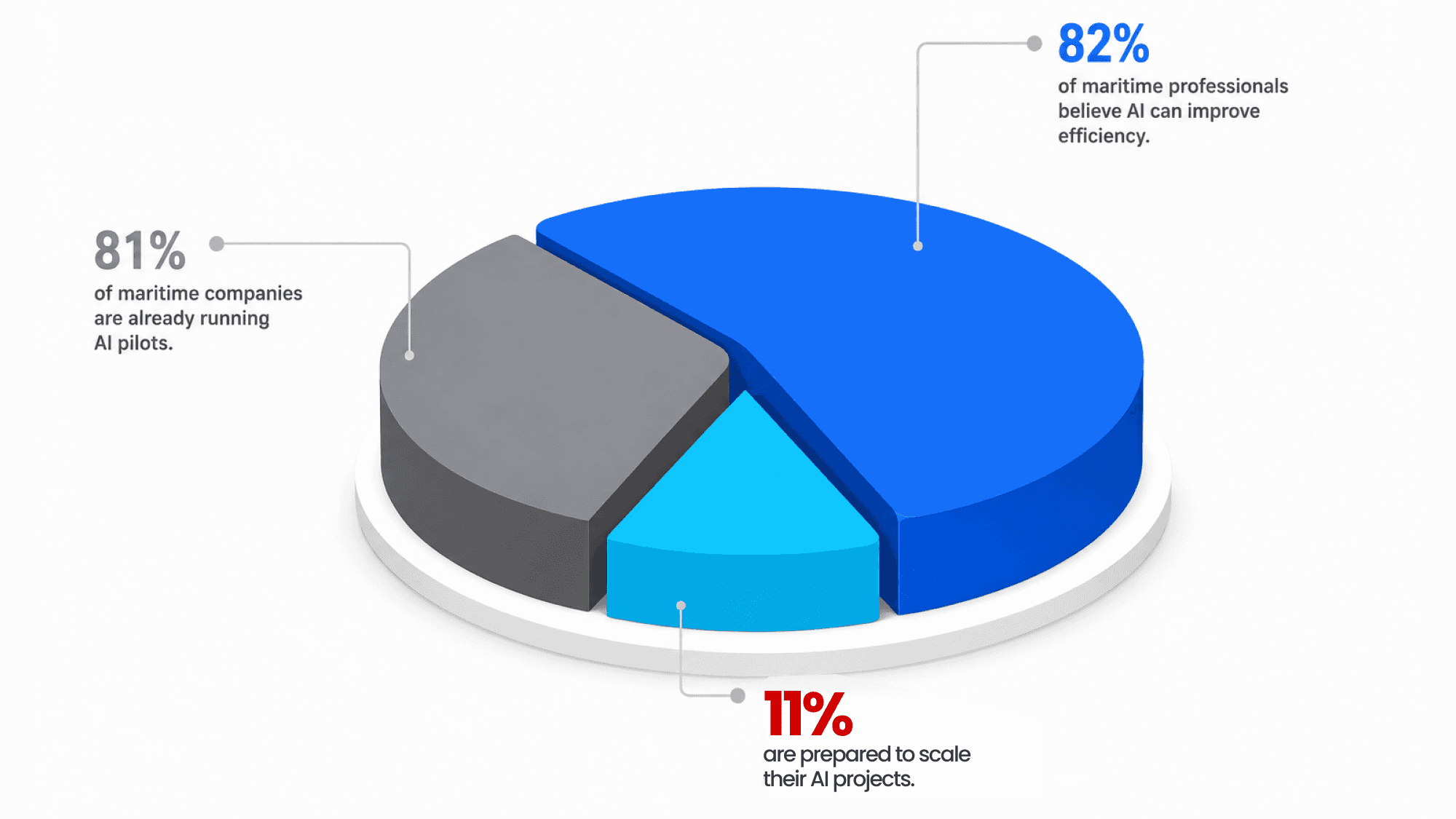
Recent industry research found that:
- 82% of maritime professionals believe AI can improve efficiency.
- 81% of maritime companies are already running AI pilots.
- Only 11% have the governance structures needed to scale these initiatives successfully.
At the same time, new regulations such as FuelEU Maritime and the IMO's Net-Zero Framework are increasing pressure on shipping companies to modernize operations and improve environmental performance.
The urgency around transformation was also evident at Posidonia 2026, where AI implementation, decarbonization, and operational efficiency emerged as some of the industry's most discussed priorities.
How Artificial Intelligence Is Driving Maritime Transformation
Artificial intelligence is becoming one of the biggest drivers of maritime innovation and maritime automation, helping organizations move from reactive operations to data-driven decision making.
Across the industry, AI is being used for:
- Email and workflow automation
- Fleet intelligence and predictive analytics
- Document processing and data extraction
- Predictive maintenance
- Voyage planning and optimization
The focus is shifting from adopting AI for innovation's sake to implementing solutions that deliver measurable business outcomes.
The most successful initiatives are solving practical problems such as reducing administrative workloads, improving decision-making, and increasing operational visibility.
Why Data Is the Foundation of Successful Maritime Transformation
Technology initiatives often fail because organizations underestimate the importance of data.
Shipping companies generate vast amounts of information from vessels, equipment, commercial operations, and regulatory reporting. However, this information frequently remains fragmented across different systems.
Successful maritime transformation requires:
- High-quality and accessible data
- A single source of truth
- Integration between ship and shore systems
- Strong data governance practices
Without a solid data foundation, even the most advanced technologies struggle to deliver meaningful business value.
How Decarbonization Is Shaping Maritime Transformation
Maritime decarbonization is becoming one of the biggest catalysts for transformation across the shipping industry.
The introduction of FuelEU Maritime and the IMO's Net-Zero Framework is pushing shipping companies to rethink fuel strategies, energy efficiency initiatives, and operational processes.
Companies are increasingly investing in:
- Emissions monitoring platforms
- Fuel optimization solutions
- Voyage optimization tools
- Digital twins
- Alternative fuel readiness
Decarbonization is no longer just an environmental objective. It is becoming a commercial and operational necessity.
The Role of Intelligent Automation in Maritime Transformation
Intelligent automation is emerging as a critical component of maritime digitalization, helping companies reduce manual work and improve operational efficiency in shipping.
Teams spend considerable time processing emails, handling invoices, preparing compliance reports, and managing documentation.
Intelligent automation is helping organizations:
- Reduce administrative workloads
- Improve data accuracy
- Speed up decision-making
- Free employees to focus on higher-value activities
As operational complexity grows, automating repetitive work is becoming an essential component of maritime transformation.
How Smart Ships and Connected Fleets Are Advancing Maritime Transformation
The shipping industry is becoming increasingly connected.
Modern vessels are equipped with sensors and communication technologies that provide real-time operational data.
Connected fleets and smart vessels are enabling companies to:
- Monitor vessel performance remotely
- Implement condition-based maintenance
- Improve operational visibility
- Reduce unplanned downtime
- Make faster and more informed decisions
Smart shipping is transforming how companies manage fleets and optimize performance across their operations.
Why Cybersecurity Has Become Essential to Maritime Transformation
As shipping becomes more digital, cyber risks continue to grow.
Modern vessels rely on interconnected systems that support navigation, communication, and operational activities. A cyber incident can disrupt operations, compromise safety, and create significant financial consequences.
Industry organizations increasingly view cybersecurity as a critical business risk rather than simply an IT concern.
Building cyber resilience has become a fundamental requirement for successful maritime transformation.
The Human Side of Maritime Transformation: Skills, Culture, and Change Management
As digital transformation in shipping accelerates, organizations must invest in people and change management alongside technology.
Research shows that many AI initiatives fail because organizations focus on technology implementation without addressing adoption and change management.
Successful transformation requires:
- Upskilling employees
- Building digital capabilities
- Creating internal champions
- Encouraging collaboration between operational teams and technology teams
The companies achieving the greatest results are those that combine technology investments with organizational change.
The Biggest Challenges Slowing Maritime Transformation
Despite growing investment, many maritime transformation initiatives fail because organizations underestimate the complexity of operational change.
Common challenges include:
- Legacy systems and outdated processes
- Lack of digital expertise
- Resistance to organizational change
- Poor data quality
- Technology-first thinking
- Difficulty demonstrating return on investment (ROI)
Overcoming these challenges requires a clear strategy, executive commitment, and a focus on solving real operational problems.
The Future of Maritime Transformation: What Comes Next for the Shipping Industry
The next phase of maritime transformation will be defined by the ability to combine technology, people, and data into resilient operating models.
Industry leaders will increasingly focus on:
- Solving operational bottlenecks
- Building strong data foundations
- Investing in workforce capabilities
- Scaling practical AI use cases
- Measuring business outcomes instead of technology deployments
The future belongs to organizations that successfully combine technology, people, and processes to create smarter and more resilient maritime operations.
Conclusion
Maritime transformation in 2026 is being shaped by artificial intelligence, automation, data, sustainability, and connected operations.
The future of shipping will belong to organizations that successfully combine maritime digital transformation, smart shipping technologies, and operational expertise to build resilient, efficient, and future-ready businesses.