
 Maritime

Introduction
Shipping companies process thousands of documents every day, from Bills of Lading and Charter Parties to invoices and compliance records. Choosing between OCR and AI can be confusing, especially when both technologies are often presented as the same.
This guide explains how OCR and AI differ, how they work together in maritime document processing, and when shipping companies should move beyond OCR to automate complex workflows more effectively.
What Is OCR?
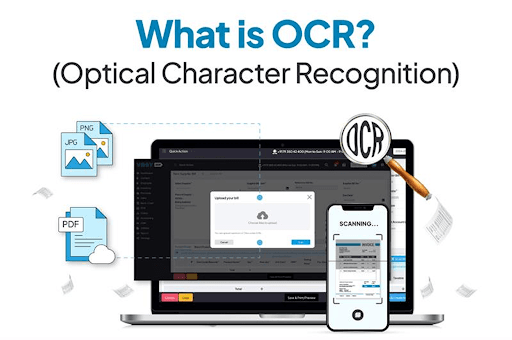
OCR (Optical Character Recognition) is a technology that converts text from scanned documents, PDFs, images, or paper records into machine-readable text.
Instead of manually typing information from paper documents, OCR automatically recognizes printed characters and makes the content searchable and editable.
OCR can process:
- Scanned PDFs
- Images
- Printed shipping documents
- Paper records
- Some handwritten text (with varying accuracy)
What Is AI Document Processing?
Unlike OCR, AI document processing does much more than convert images into text.
Artificial Intelligence understands the information inside a document and performs tasks that traditionally required manual review.
AI can:
- Understand document context
- Classify document types
- Extract important fields
- Validate information
- Compare multiple documents
- Detect anomalies
- Summarize lengthy reports
- Trigger automated workflows
A simple way to understand the difference is:
OCR teaches a computer to read.
AI teaches a computer to understand what it has read.
For example, AI can recognize that a document is a Charter Party, identify the laycan dates, vessel details, charterer information, and freight terms, then automatically compare those details with a Fixture Recap or Statement of Account.
This capability makes intelligent document processing particularly valuable for document-heavy maritime operations.
Why Maritime Documents Are More Complex
Shipping companies process some of the most complex business documentation found in any industry.
Unlike standardized invoices or purchase orders, maritime documentation comes from multiple organizations, countries, ports, and shipping partners, each using different formats and templates.
Common challenges include:
- Different document layouts
- Multiple file formats
- Low-quality scanned PDFs
- Handwritten notes
- Email attachments
- Tables and structured data
- Different languages
- Regulatory requirements
- Multiple stakeholders reviewing the same document
Maritime organizations regularly process documents such as:
- Bills of Lading
- Charter Parties
- Statements of Account (SOA)
- Noon Reports
- Cargo Manifests
- Crew Certificates
- Port Clearance Documents
- Customs Declarations
- Invoices
- Purchase Orders
Because these documents vary significantly in structure, relying solely on OCR in the maritime industry often results in manual verification and additional administrative work.
How OCR Is Used in Shipping
OCR has been helping shipping companies digitize paperwork for many years.
Typical OCR applications include:
- Reading vessel names
- Extracting IMO numbers
- Capturing invoice amounts
- Digitizing historical paper archives
- Reading packing lists
- Processing Bills of Lading
- Digitizing cargo manifests
- Reading certificates
- Converting scanned PDFs into searchable documents
OCR performs particularly well when documents are:
- Clean and high quality
- Printed clearly
- Based on standard templates
- Consistently formatted
For repetitive document digitization, OCR remains a valuable technology.
However, once documents become more complex or require interpretation, OCR alone is no longer enough.
How AI Improves Maritime Documentation
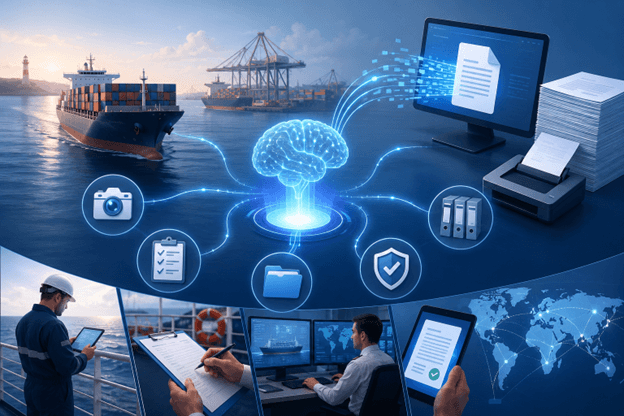
AI Extracts Important Information
AI document extraction automatically identifies critical fields such as:
- Vessel Name
- IMO Number
- Cargo Quantity
- Port of Loading
- Port of Discharge
- Laycan
- Charterer
- Consignee
- Invoice Amount
- Purchase Order Number
Unlike traditional OCR, AI can locate these fields even when documents use different layouts.
AI Validates Information
AI can automatically detect:
- Expired certificates
- Missing signatures
- Duplicate invoices
- Incorrect voyage numbers
- Missing mandatory fields
- Invalid dates
- Data mismatches
This reduces manual review and helps improve compliance.
AI Compares Documents
AI can compare information across multiple documents, including:
- Invoice vs Purchase Order
- Bill of Lading vs Cargo Manifest
- Statement of Account vs Fixture Recap
- Charter Party vs Previous Charter Party
Instead of manually reviewing hundreds of pages, teams receive highlighted differences immediately.
AI Summarizes Long Documents
Lengthy documents can be summarized automatically, including:
- Inspection reports
- Port State Control findings
- Survey reports
- Charter Parties
- Operational reports
This allows operations teams to identify key issues much faster.
AI Routes Documents Automatically
Once documents are processed, AI can automatically send them to the appropriate department.
Examples include:
- Operations
- Chartering
- Finance
- Compliance
- Procurement
This significantly reduces manual coordination and speeds up document approvals.
OCR and AI are only part of a wider shift towards smarter document workflows. Learn more about how maritime operators can reduce documentation time with AI.
| Feature | OCR | AI |
|---|---|---|
| Reads text | Yes | Yes |
| Understands document meaning | No | Yes |
| Classifies documents | No | Yes |
| Extracts key fields | Limited | Yes |
| Detects missing information | No | Yes |
| Validates data | No | Yes |
| Finds anomalies | No | Yes |
| Matches related documents | No | Yes |
| Summarizes reports | No | Yes |
| Learns from document variations | No | Yes |
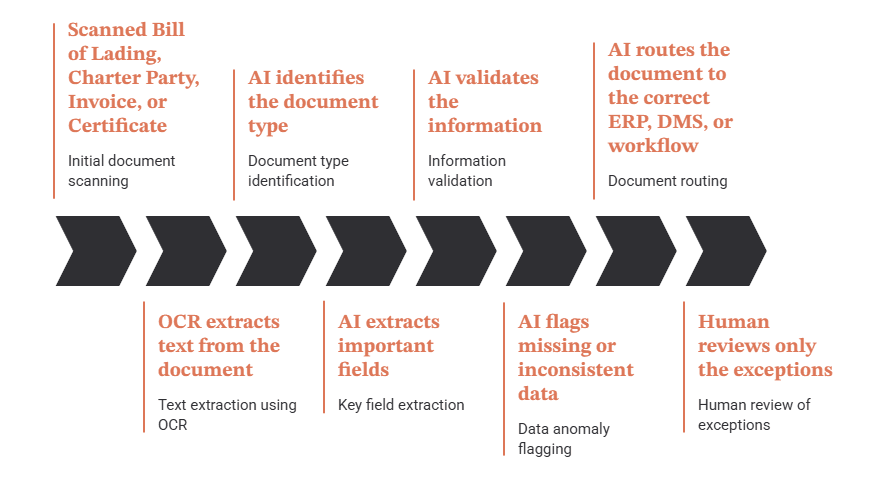
How OCR and AI Process a Maritime Document
Why Maritime Operations Still Need Human Oversight
Despite rapid advances in AI, maritime operations still require experienced professionals to make critical decisions.
AI is designed to reduce repetitive administrative work, not replace human expertise.
Human review remains essential for:
- Charter Party negotiations
- Compliance documentation
- Customs declarations
- Regulatory exceptions
- Audit records
- High-value commercial decisions
For example, AI may identify a missing signature or detect a discrepancy between two documents, but a shipping professional still decides how that issue should be resolved.
The goal of AI is to improve operational efficiency while allowing experienced teams to focus on decisions that require industry knowledge and judgment.
When Should Shipping Companies Move Beyond OCR?
Many shipping companies start with OCR and later realize they still spend significant time manually reviewing documents.
If your teams are experiencing any of the following challenges, it may be time to move beyond OCR:
- Staff manually checking extracted data
- Processing documents from multiple templates
- Frequent compliance errors
- High volumes of invoices and operational documents
- Teams copying information between systems
- Slow invoice approval cycles
- Difficulty locating historical documents
- Manual comparison of Charter Parties, SOAs, and Bills of Lading
- Increasing administrative workload as the business grows
In these situations, intelligent document processing powered by AI can reduce manual effort, improve data accuracy, and accelerate document-driven workflows.
Conclusion
OCR gives shipping companies digital documents. AI gives those documents context, intelligence, and the ability to automate work. For organizations handling thousands of maritime documents every month, combining OCR with AI is no longer just an efficiency upgrade. It is becoming the foundation for faster operations, fewer errors, and more scalable document management.