
 Maritime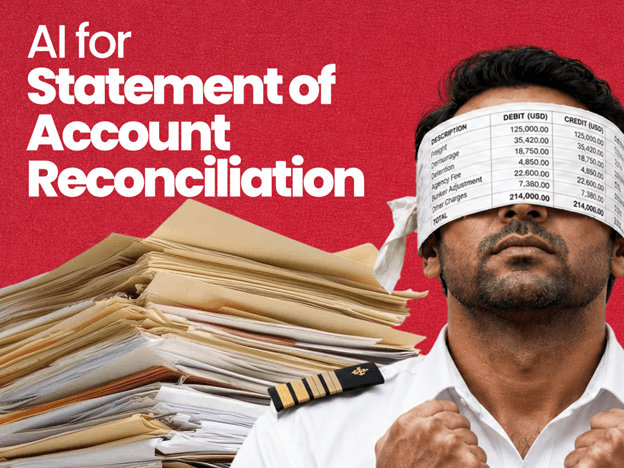

Introduction
At the end of every month, finance teams across shipping companies receive Statements of Account from port agents, bunker suppliers, technical vendors, and service providers.
At first glance, the process looks straightforward, compare the supplier's statement with the company's ERP records and confirm the balance.
In reality, it rarely is.
The same invoice might appear under different reference formats, a single payment may settle multiple invoices, credit notes may be issued weeks later, and transactions can span multiple vessels, currencies, and legal entities.
Most of the effort isn't spent finding discrepancies. It's spent understanding why they exist.
This is where AI-assisted Statement of Account reconciliation can significantly reduce manual effort while keeping finance teams in control.
Why SOA Reconciliation Is More Complex Than It Looks
Statement of Account reconciliation is not simply about checking whether two closing balances match. Teams need to verify the individual transactions behind those balances.
In maritime, this becomes more complex because transactions may involve multiple vessels, vendors, entities, currencies, and document formats.
Common issues include:
- Different invoice reference formats
- Missing invoices or credit notes
- Duplicate transactions
- Partial or combined payments
- Different vessel references
- Currency and amount differences
- Transactions recorded on different dates
Finding a mismatch is often easy. Understanding why it happened takes most of the time.
What Is a Statement of Account Reconciliation?
Statement of Account reconciliation is the process of comparing an external SOA with a company's internal records to identify matching transactions, investigate discrepancies, and confirm that balances are correctly recorded.
For a maritime company, this may involve checking:
- Invoice verification
- Transaction verification
- Payment records
- Credit and debit notes
- Transaction dates
- Currency
- Vessel references
- Outstanding balances
The goal is to identify which transactions match and which require further investigation.
Where Is SOA Reconciliation Used in Maritime Operations?
Maritime companies work with a large network of vendors and service providers across vessels, ports, and regions. Each of these relationships can generate invoices, payments, credit notes, and outstanding balances that need to be verified.
SOA reconciliation may be required for accounts involving:
- Port agents
- Bunker suppliers
- Ship chandlers
- Technical and maintenance vendors
- Spare parts suppliers
- Logistics and freight service providers
- Other vessel-related service providers
As the number of vessels and vendors increases, finance teams may need to reconcile a growing number of transactions across different systems, currencies, and entities.
This makes SOA reconciliation an important control for identifying missing transactions, incorrect balances, and unresolved discrepancies.
How Is Statement of Account Reconciliation Done Manually?
Manual SOA reconciliation usually involves downloading the statement, exporting internal transaction records, and comparing both datasets line by line.
A typical process looks like this:
- Receive the SOA from a vendor or counterparty
- Export the relevant internal transaction records
- Prepare both datasets for comparison
- Match invoice numbers, amounts, and references
- Identify missing or mismatched transactions
- Investigate exceptions
- Update the reconciliation status
This process becomes difficult to scale when a maritime company manages large transaction volumes across multiple vessels and vendors.
The Biggest Challenges in Manual SOA Reconciliation
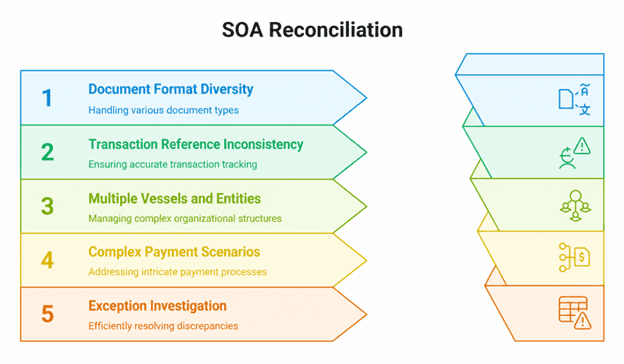
Different document formats
SOAs may arrive as Excel files, PDFs, or scanned documents. Teams often need to organise the data before verification can even begin.
Inconsistent transaction references
The same invoice may appear as INV-45892 in one system and INV45892 in another. Exact-match methods may incorrectly treat them as separate transactions.
Multiple vessels and entities
A transaction may need to be matched not only by invoice number but also by vessel, vendor, currency, or legal entity.
Complex payment scenarios
One payment may cover several invoices, while some invoices may be partially paid. Credit notes can add another layer of complexity.
Time spent investigating exceptions
The biggest challenge is often not finding a mismatch but determining why it exists. Teams may need to check supporting documents, payment records, and internal systems before resolving it.
Common SOA Discrepancies in Maritime
Not every difference between a supplier's SOA and internal records means that a transaction is incorrect. Sometimes, the same transaction is simply recorded differently across systems.
For example, a supplier SOA may show 120 outstanding invoices while the company's internal records show 116. The difference could be caused by:
- An invoice missing from the internal system
- A payment not yet reflected in the supplier's statement
- A credit note recorded on only one side
- A duplicate transaction
- One payment covering multiple invoices
- Different invoice reference formats
- A transaction recorded against a different vessel or legal entity
- Timing differences between the two records
The challenge is therefore not only identifying that a difference exists. Finance teams also need to understand the reason behind it before the account can be reconciled.
How Can AI Automate Statement of Account Reconciliation?
AI can support SOA reconciliation by extracting transaction data, standardising records, matching transactions, and identifying exceptions.
A typical AI-assisted workflow can follow five steps:
1. Extract data
Relevant information such as invoice numbers, dates, amounts, currencies, and vessel references is extracted from the SOA.
2. Standardise records
Differences in invoice formats, dates, and other references are normalised before comparison.
3. Match transactions
The system compares the SOA with internal records using invoice references, amounts, dates, vessel information, and other available fields.
4. Identify discrepancies
Potential issues such as missing invoices, amount differences, duplicate transactions, and unmatched payments are flagged.
5. Send exceptions for review
Transactions that cannot be confidently matched are presented to the relevant team for investigation.
This changes the workflow from:
Checking every transaction manually
to:
Reviewing only the transactions that require attention.
What Can AI Check During SOA Reconciliation?
An AI-assisted system can help check whether:
- An invoice exists in both records
- Invoice references match despite formatting differences
- Transaction amounts are consistent
- Payments have been correctly matched
- Credit notes are reflected
- Duplicate transactions exist
- Transactions are missing from either record
- The correct vessel or entity is associated with the transaction
The exact verification logic should depend on the company's existing processes and business rules.
Benefits of AI-Assisted SOA Reconciliation
Less manual checking
Teams can spend less time comparing transactions that already match.
Faster discrepancy detection
Missing invoices, unmatched payments, and other exceptions can be identified earlier.
Better handling of inconsistent data
The system can identify potential matches even when transaction references are formatted differently.
More consistent verification
The same matching rules can be applied across different statements and vendors.
Easier scaling
As transaction volumes increase, routine matching can be automated while teams focus on complex cases.
Manual vs AI-Assisted SOA Reconciliation
| Area | Manual Reconciliation | AI-Assisted Reconciliation |
|---|---|---|
| Data preparation | Records manually organized | Data automatically extracted and structured |
| Transaction matching | Line-by-line comparison | Automated matching across multiple fields |
| Reference differences | Manually investigated | Formatting differences normalized |
| Discrepancies | Found during manual review | Missing, duplicate, or mismatched records flagged |
| Complex cases | Every transaction reviewed | Exceptions prioritized for human review |
| Scalability | Workload grows with volume | Routine matching scales automatically |
AI does not need to make every reconciliation decision. Its main value is automating routine matching so finance teams can focus on exceptions that require investigation.
Where Is Human Review Still Needed?
Human review remains important when the system cannot confidently determine whether transactions match.
This may include:
- Multiple possible matches
- Partial or combined payments
- Unusual amount differences
- Missing supporting documents
- Disputed invoices
- Transactions linked to the wrong vessel or entity
A practical system can automatically process high-confidence matches while sending uncertain cases for review.
The goal is not to remove human control. It is to use human attention where it adds the most value.
Questions to Ask Before Automating SOA Reconciliation
Before introducing automation, maritime companies should first understand where the most manual effort occurs in their existing verification process.
Useful questions include:
- How many Statements of Account are processed each month?
- Which vendors generate the highest transaction volumes?
- How much time is spent manually matching transactions?
- What types of discrepancies occur most frequently?
- Which fields are currently used to match transactions?
- Are internal transaction records available in a consistent format?
- Which exceptions always require human review or approval?
Answering these questions helps identify the best workflow to automate first.
Rather than trying to automate every SOA process at once, companies can start with a high-volume and relatively structured workflow, measure the results, and expand from there.
How to Start Automating SOA Reconciliation
Maritime companies do not need to automate every vendor and account from day one.
A practical approach is to start with one high-volume SOA workflow, define clear matching rules, and test the system using historical data with known results.
Measure the automatic match rate, false matches, exceptions identified, processing time, and manual review required.
Once the workflow performs reliably, it can gradually be expanded to more vendors, vessels, and transaction types.
SOA verification is one example of how AI can reduce repetitive document review. Explore how maritime operators can reduce documentation time with AI across other workflows.
Conclusion
SOA verification in maritime can become complex when transactions are spread across multiple vessels, vendors, currencies, and systems.
AI can help automate data extraction and transaction matching while highlighting discrepancies for human review.
The biggest opportunity is simple: instead of manually checking every transaction to find a few exceptions, let technology identify where human attention is actually needed.