
 Maritime

Your PMS Already Has the Data. So What Is Missing?
A planned maintenance system for ships already holds valuable information about a vessel's maintenance: equipment history, completed jobs, running hours, spare parts and maintenance records.
But having the information is only part of the problem.
Engineers still have to enter it. Superintendents still have to search for it. Teams still have to connect it with information sitting in other systems.
So the question for ship managers is no longer simply "Should we use AI?"
It is: "What can AI actually do with the PMS we already have?"
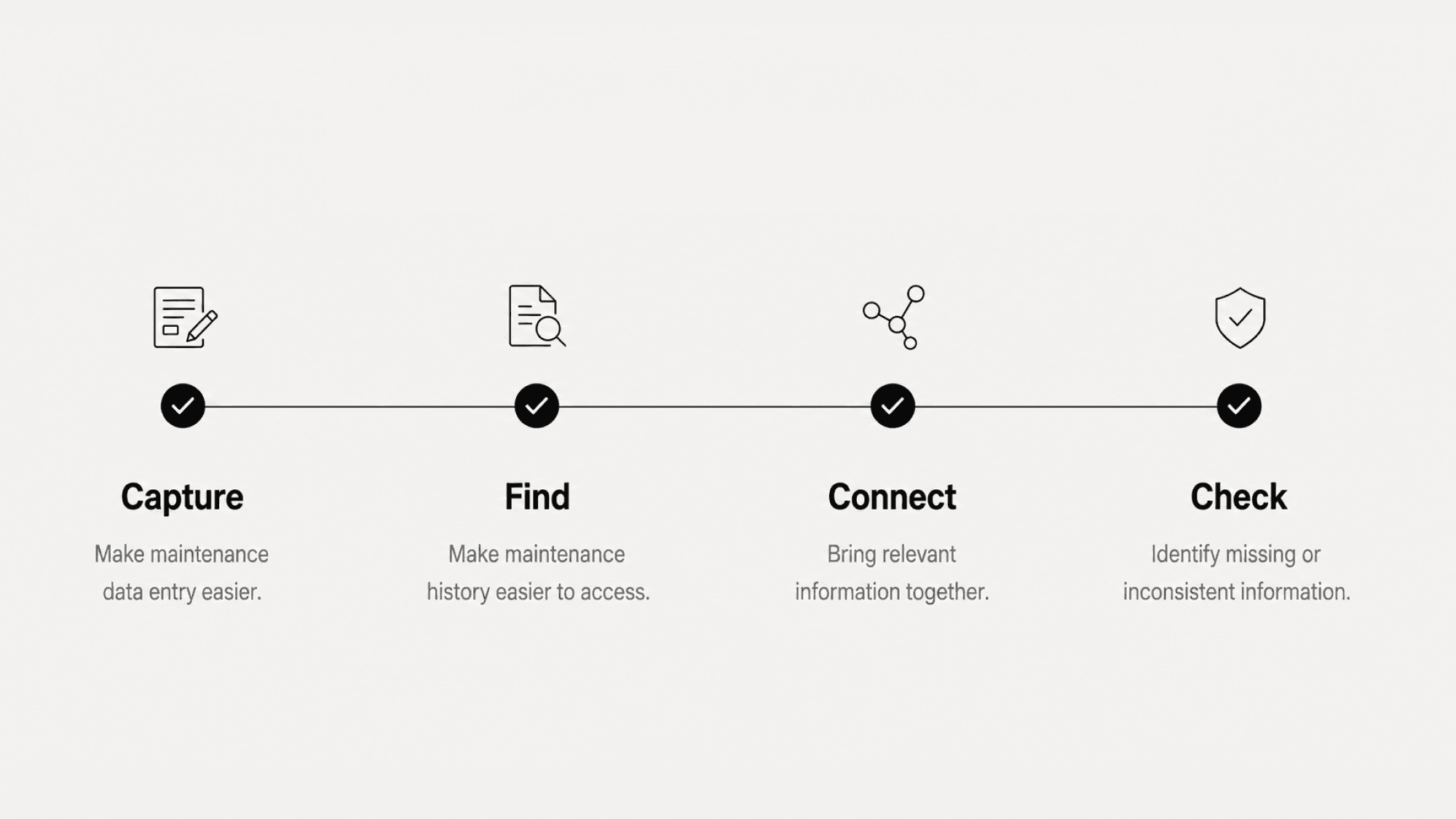
This article looks at four practical areas where AI could help: entering maintenance information, finding maintenance history, understanding machinery history and checking information across systems.
The goal is simple: Make the information already inside your PMS more useful.
What Does a Traditional PMS Actually Do?
A Planned Maintenance System, or PMS, is fundamentally a system of record for vessel maintenance.
It helps maritime teams schedule maintenance, manage work orders, track equipment, record running hours, manage maintenance history and monitor spare-part usage.
For ship managers and technical superintendents, it answers questions such as:
- What maintenance is due?
- What has been completed?
- When was equipment last serviced?
- What parts were used?
- What maintenance has been performed before?
This foundation is essential.
But a system of record is not necessarily a system of intelligence.
The PMS stores the information. People still have to search for it, interpret it and connect it with information from other sources.
That is where AI changes the equation.
Where AI Can Add Value to an Existing PMS
AI does not necessarily need to replace a PMS. It can add an intelligence layer that improves how maintenance information is captured, accessed, connected and used.
Use Case 1: Log Completed Maintenance
The problem:
Engineers often have to enter completed maintenance manually, even when they already know what work was done.
What an old PMS does:
The engineer selects the job and manually fills in the required fields, remarks, parts used and other details.
What an AI-assisted PMS could do:
AI can help turn the engineer's description of the work into a structured maintenance entry, identify missing information and let the engineer review it before saving.

Use Case 2: Finding Maintenance History
The problem:
A PMS can contain years of maintenance records, but finding the right information can take time.
What an old PMS does:
Users search for the equipment, apply filters and go through individual records to find the required history.
What an AI-assisted PMS could do:
AI can understand a question in plain language, find the relevant maintenance records and summarize the available history.
Use Case 3: Understand Machinery History
The problem:
Understanding what happened to a piece of equipment may require looking through multiple maintenance records and other related information.
What an old PMS does:
Users review previous jobs and records individually to understand the equipment's history.
What an AI-assisted PMS could do:
AI can bring together relevant maintenance records and, where connected and authorized, related information from documents or other systems to provide a clearer view of the machinery's history.
Use Case 4: Flag Data Inconsistencies
The problem:
The same maintenance information may be recorded in different places, such as the PMS, noon reports and charterer reports. When these records are updated separately, the information may not always match.
What an old PMS does:
It stores the information entered into the PMS, but does not necessarily check it against related information recorded elsewhere.
What an AI-assisted PMS could do:
AI can compare information across connected records and flag possible mismatches, missing updates or conflicting information for the user to review.

AI Cannot Fix Poor Data on Its Own
AI is only as good as the information it works with.
This is becoming increasingly important as maritime companies adopt more digital technologies. Lloyd’s Register has highlighted a “digital disconnect” in shipping, where disconnected systems, data and operational processes can prevent companies from fully realizing the value of digital technologies.
The problem can exist even inside a single PMS.
If two engineers record the same job differently, the PMS may end up with inconsistent information. The same can happen with equipment names, spare parts, maintenance remarks and other records.
AI can help identify and standardize some of these differences, but it cannot fix missing or incorrect information by itself.
The key is simple: AI can improve how data is used, but good data still matters.
That is why AI should be introduced into useful workflows, where it can help people enter, find and check information more effectively.
Does AI Mean Replacing Your Existing PMS?
Not necessarily.
A PMS already holds important maintenance information. The goal does not always need to be replacing it with a new system.
Most maritime companies already use several systems for different activities, including:
- PMS
- ERP
- Inventory
- QHSE
- Documents
AI can work with these existing systems and help bring relevant information together.
The idea is simple:
Existing PMS → AI Layer → People
The PMS continues to store the maintenance information.
AI helps people find, understand and use it more easily.
This also means companies can start with one useful workflow instead of changing their entire technology setup.
PMS as a System of Record, AI as a System of Intelligence
A PMS is good at storing and managing information.
It tells you:
- What happened
- When it happened
- What maintenance was completed
- What parts were used
- What maintenance is due
AI can help people make better use of that information.
It can help answer:
- What information is relevant?
- Has this happened before?
- Is anything missing or inconsistent?
- What patterns can be seen in the records?
- What information should I look at before making a decision?
So the roles are different:
PMS: Stores the information.
AI: Helps people use the information.
They do not need to replace each other.
What Could an AI-Assisted PMS Look Like?
| Area | Traditional PMS | AI-Assisted PMS |
|---|---|---|
| Maintenance entry | Enter information manually | Help structure the entry |
| Finding history | Search and filter records | Ask and retrieve |
| Equipment history | Review records | Bring relevant records together |
| Data checking | Store what is entered | Flag possible issues |
| Maintenance analysis | Review reports | Highlight useful patterns |
| Using the system | Navigate menus | Use simple questions |
Where Should a Ship Manager Start?
The question should not be: "Where can we add AI?"
It should be: "Where are our teams spending unnecessary time?"
Start with one workflow where AI can make a clear difference.
For example:
What AI Still Cannot Replace
AI can help people work with maintenance information faster.
It does not replace:
- Engineering judgment
- Human verification
- Operational experience
- Responsibility for maintenance decisions
For maintenance workflows, the principle is simple:
AI helps.
People verify.
The PMS records.
The goal is not to remove people from the process.
It is to remove unnecessary work from it.
Conclusion: Make Your Existing PMS More Useful
Your PMS already contains years of maintenance information.
The opportunity with AI is not necessarily to replace it.
It is to make that information easier to enter, find, understand and check.
The evolution does not have to be:
PMS → Replace PMS → New AI System
It can be:
PMS → PMS + AI → Smarter Maintenance Workflows
The PMS remains the system of record.
AI helps people get more value from the information already inside it.
The question is not whether your PMS has AI.
It is what your existing PMS could do better with it.