
AI marketing services are professional services that set up, connect or manage AI for marketing work such as content creation, lead qualification, email campaigns and reporting. They range from configuring an existing tool to building custom automations across your CRM and ad platforms, with pricing set by scope, integrations and ongoing support.
Marketing teams use AI for content creation, lead management, email campaigns, and reporting. But choosing between AI tools, marketing agencies, and custom automation services isn’t always straightforward.
AI marketing services help businesses implement, manage, or customize AI-powered marketing processes. Depending on the problem, this could mean setting up an existing tool, outsourcing campaign execution, or connecting several systems through automation.
This guide explains what services are available, how much they cost, and how to decide which approach suits your business.
What Are AI Marketing Services?
AI marketing services are professional services that use artificial intelligence to support marketing activities such as content creation, customer segmentation, lead qualification, campaign optimization, and analytics.
Unlike standalone AI software, these services may include strategy, implementation, integration, customization, and ongoing support.
For example, an AI writing tool can draft an email. An AI marketing automation service could connect a website enquiry to your CRM, extract customer requirements, assign the lead, and prepare a follow-up.
According to HubSpot’s 2026 State of Marketing Report, about 80% of surveyed marketers use AI for content creation, either extensively or occasionally, demonstrating how widely AI has entered marketing workflows.
However, using AI tools and having an integrated marketing process are not the same thing.
What Types of AI Marketing Services Are Available?
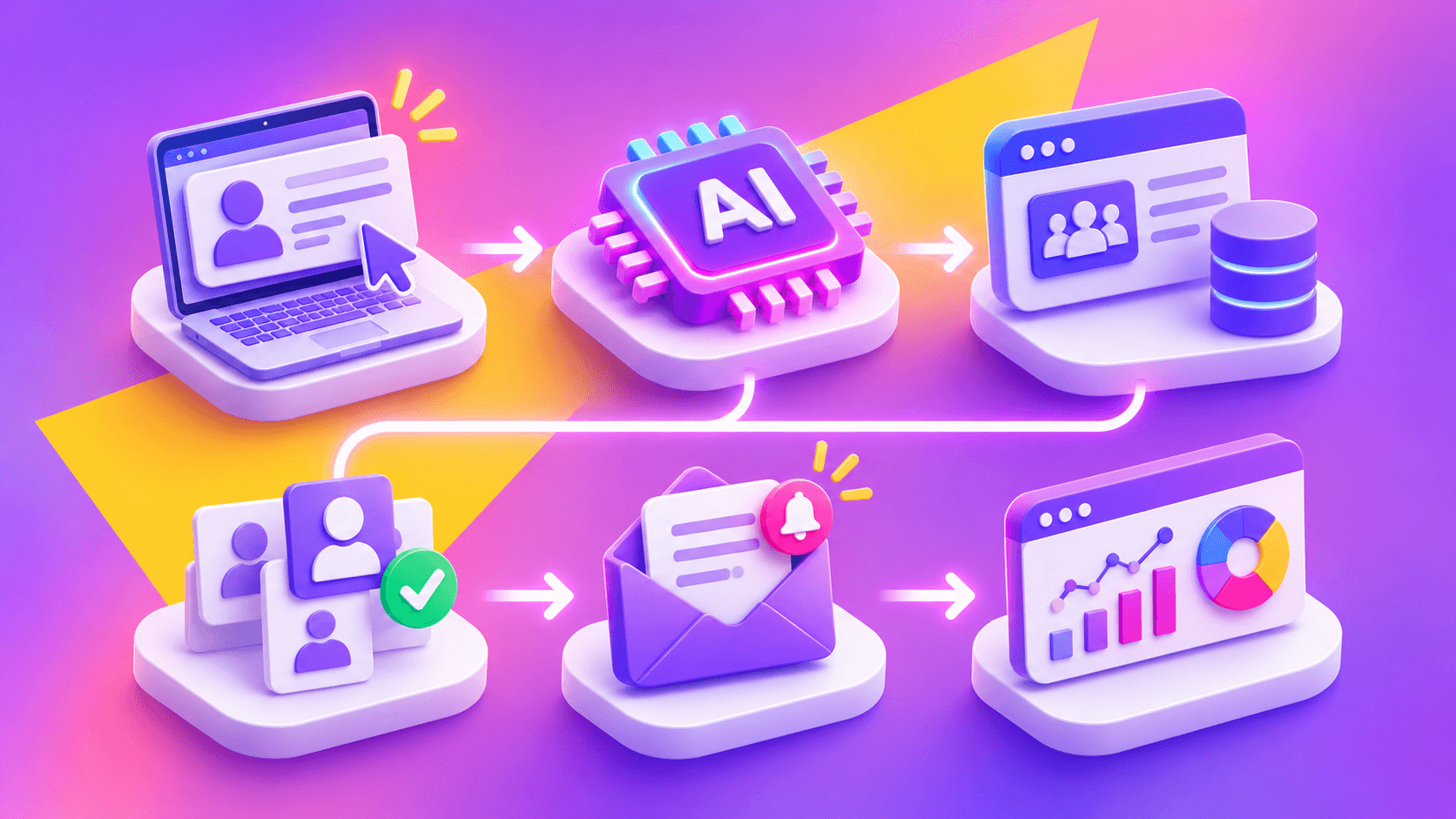
The right service depends on the problem your business needs to solve.
| AI marketing service | What it helps with | Example use case |
| AI content marketing | Content planning, drafts, visuals, campaigns | Creating campaign assets from one brief |
| AI marketing automation | Repetitive tasks and connected workflows | Automatically updating CRM records |
| AI lead generation | Lead classification, enrichment, qualification | Identifying and routing relevant enquiries |
| AI email marketing | Segmentation and personalized communication | Preparing follow-ups for different customer groups |
| AI SEO services | Research, content analysis, optimization | Identifying content gaps |
| AI advertising | Campaign analysis and creative testing | Reviewing underperforming ads |
| AI marketing analytics | Reporting and performance insights | Combining CRM and campaign data |
AI Content Creation and Campaign Management
AI can help prepare campaign ideas, blog drafts, social media posts, email content, and advertising variations.
A provider may also build a workflow connecting content planning, creation, approval, and publishing.
Best for: Businesses producing regular marketing content with limited time or resources.
AI Marketing Automation
AI marketing automation connects tasks across tools and reduces manual coordination.
For example:
Customer enquiry → AI extracts details → CRM updated → Lead assigned → Follow-up prepared.
This can be useful when marketing and sales teams repeatedly transfer information between forms, inboxes, and CRM systems.
AI Lead Generation and Qualification
AI can help organize incoming leads, extract customer requirements, and classify enquiries using defined criteria.
Best for: Businesses receiving enquiries from multiple channels and struggling to prioritize responses.
AI-generated classifications should be checked against actual lead quality rather than treated as guaranteed predictions.
AI Email Marketing and Personalization
AI can support audience segmentation, email drafting, follow-up sequences, and campaign analysis.
For example, new enquiries and existing customers may receive different communications based on their requirements and permitted data.
AI SEO and Content Optimization
AI SEO services can support keyword research, content audits, search intent analysis, and optimization recommendations.
However, AI-generated recommendations require verification, and no provider can guarantee Google rankings.
AI Advertising and Campaign Optimization
AI can help analyze advertising performance, prepare creative variations, and identify campaigns requiring attention.
Many advertising platforms, such as Google Ads Performance Max, already include AI-based optimization, so a service provider may focus on strategy, tracking, and correct implementation rather than developing a separate system.
AI Marketing Analytics and Reporting
AI can help interpret data from CRM, advertising, email, and analytics platforms.
This is particularly useful when marketing teams spend time preparing recurring reports or investigating inconsistent data.
How Do AI Marketing Services Work?
Most implementation projects follow a similar process:
1. Identify the problem: Determine which marketing activity is slow, repetitive, or difficult to manage.
2. Review existing systems: Assess the CRM, marketing tools, data quality, and integration options.
-
Choose the solution: Decide whether existing software, traditional automation, or custom AI is appropriate.
-
Implement and test: Connect the workflow, check accuracy, and handle exceptions.
5. Measure results: Compare time, cost, errors, and business outcomes before and after implementation.
The objective is to improve a specific process, not introduce AI into every marketing activity.
What Are the Benefits of AI Marketing Services?
The main benefits are operational efficiency, faster execution, and better use of marketing information.
| Potential benefit | How to measure it |
| Less manual work | Hours spent on repetitive tasks |
| Faster lead follow-up | Average response time |
| More consistent campaigns | Approval delays and missed deadlines |
| Better reporting | Time required to prepare reports |
| Improved lead handling | Qualified leads and conversion rates |
These are potential benefits, not guaranteed outcomes.
In Salesforce’s tenth State of Marketing report, 75% of marketers said they had adopted AI, but only 13% had adopted agentic AI.
This highlights an important challenge: adopting AI tools is often easier than connecting them into reliable business workflows.
AI Marketing Services vs. AI Tools vs. Traditional Agencies
Businesses typically have four options.
| Option | Best for | Main consideration |
| AI marketing tools | Teams managing their own marketing | Requires internal setup and operation |
| Traditional marketing agency | Outsourcing campaign strategy and execution | May not address internal automation |
| AI marketing agency | Managed AI-assisted marketing campaigns | Services vary by provider |
| AI automation partner | Custom workflows and system integrations | Requires implementation and technical support |
Which Option Should Your Business Choose?
Choose an AI tool when you need a common capability, such as generating content or scheduling emails.
Choose a marketing agency when you need external expertise to plan and manage campaigns.
Choose an AI automation partner when your main problem involves disconnected systems, manual handoffs, or specialized workflows.
For example, if your marketing team already uses a CRM but manually transfers every website enquiry into it, hiring another agency may not solve the problem. Connecting the existing systems could be more useful.
How Much Do AI Marketing Services Cost?
AI marketing services do not have one standard price. Costs depend on the service, scope, integrations, and ongoing support.
Common Pricing Models
| Model | Typical application |
| Monthly retainer | Ongoing campaign management |
| Fixed project fee | Workflow setup or custom implementation |
| Hourly consulting | Strategy, audits, specialist support |
| Performance-based | Certain lead generation engagements |
| Hybrid | Initial setup plus ongoing management |
What Affects the Final Price?
The main factors are project scope, number of integrations, data preparation, software subscriptions, AI usage, human review, and ongoing maintenance.
Before accepting a quotation, ask whether implementation, testing, software fees, support, and future changes are included.
The useful comparison is total cost versus expected business value—not simply the lowest monthly fee.
How to Choose the Right AI Marketing Service Provider
A suitable provider should understand your workflow before recommending technology.
Use this checklist when evaluating providers:
| Ask the provider | What to look for |
| What specific problem will you solve? | A clear workflow and business outcome |
| Can you integrate our existing tools? | Defined integration scope and limitations |
| How do you handle incorrect AI outputs? | Testing, safeguards, and human review |
| What does the price include? | Clear setup and recurring costs |
| How will we measure success? | Agreed baseline and relevant KPIs |
| What happens after deployment? | Maintenance, support, and ownership details |
Be cautious of guaranteed revenue claims, unclear deliverables, or recommendations to build custom AI before reviewing existing software.
When Should a Business Invest in AI Marketing Services?
AI marketing services may be worth exploring when:
• Leads are missed because follow-ups depend on manual work.
• Customer data is scattered across multiple systems.
• Campaign preparation consumes significant employee time.
• Reporting requires repeated spreadsheet updates.
• Existing tools cannot support a business-specific workflow.
• The team lacks the expertise to implement automation internally.
When might AI not be necessary?
If a task follows simple rules or existing software already solves it, traditional automation may be sufficient.
Start with one measurable problem before investing in a larger AI implementation.
What Are the Risks and Limitations?
Businesses should account for four main risks.
• Accuracy: AI-generated content and customer classifications can be incorrect (NIST describes this as confabulation, often called hallucination).
• Privacy: Customer data must be handled using appropriate permissions and applicable legal requirements, such as India’s Digital Personal Data Protection Act, 2023.
• Data quality: Incomplete CRM records and inconsistent tracking can undermine automation.
• Maintenance: Workflows require monitoring as software, campaigns, and business requirements change.
Human review remains important for sensitive communications, major budget decisions, and public-facing claims.
How to Measure ROI From AI Marketing Services

Return on investment compares the financial benefits of a solution with its total cost.
ROI (%) = (Financial benefits − Total costs) ÷ Total costs × 100
For example, suppose a business spends $5,000 implementing and operating a marketing automation workflow over a defined period. If it generates $8,000 in measurable financial benefits attributable to that workflow during the same period:
ROI = ($8,000 − $5,000) ÷ $5,000 × 100 = 60%
This is a hypothetical calculation, not a customer result.
Track the metrics that match the original problem, such as lead response time, campaign preparation hours, workflow error rates, cost per qualified lead, and conversion rates.
Remember that time saved does not automatically mean money saved, and marketing improvements should not be attributed entirely to AI without supporting evidence.
Real Example: AI-Powered Campaign Creation With Mizo
Falcon Reality developed Mizo, an AI marketing agent, to simplify campaign content creation.]
The problem: Creating a month of marketing content required separate planning, writing, design, and scheduling activities.
The solution: Mizo uses a company website and content theme to plan campaigns, generate posts and visuals, and schedule and publish content.
The documented result: One brief can produce 30 days of campaign content, with four activities connected in one workflow.
This demonstrates how AI can coordinate multiple marketing tasks instead of functioning only as a writing assistant.
How Falcon Reality Approaches AI Automation
At Falcon Reality, AI implementation begins with understanding the business workflow.
The team evaluates where work is repetitive, which systems need connecting, whether existing automation is sufficient, and where AI could add value.
For businesses managing disconnected marketing tools, manual lead handling, or repetitive campaign processes, the goal is to build a practical workflow with measurable outcomes. If you are weighing a larger build, see our guide on why businesses need custom AI solutions.
Looking to Improve Your Marketing Workflows?
Explore Falcon Reality’s AI automation services or book a consultation to identify where automation could reduce unnecessary work.