
AI marketing automation combines artificial intelligence with automated workflows to manage campaigns, process enquiries, update customer records, create content, and analyze performance. According to McKinsey's 2026 State of AI report, nearly nine in ten respondents reported regular AI use in at least one business function. However, faster execution doesn't always lead to better marketing results.
The key is knowing what to automate, where AI adds value, and which decisions need human judgement.This guide covers how AI marketing automation works, its benefits, risks, practical use cases, and how to measure ROI.
What Is AI Marketing Automation?
AI marketing automation uses artificial intelligence alongside automated workflows to support marketing activities such as lead management, customer communication, campaign creation, and reporting.
It combines two capabilities:
• Traditional automation: Executes predefined actions, such as sending a welcome email after a form submission or updating a CRM record.
• Artificial intelligence: Interprets information, identifies patterns, generates content, and supports decisions based on available data.
For example, traditional automation can send an acknowledgement email whenever a customer submits an enquiry form.
An AI-enabled workflow can also interpret the enquiry, identify the customer's requirements, categorize the request, and prepare a relevant follow-up.
The process might look like this:
Customer enquiry → AI identifies requirements → CRM record updated → Lead assigned → Follow-up prepared → Human review when needed
Not every step requires AI. Many effective workflows combine traditional automation, AI capabilities, and human oversight.
How Does AI Marketing Automation Work?
AI marketing automation connects business data, marketing platforms, AI capabilities, and predefined workflow rules. Most workflows can be understood through five stages.
1. Trigger
An event starts the workflow, such as a customer submitting a form, replying to an email, or completing a purchase.
2. Collect Information
The system retrieves relevant information from connected sources, including CRM records, website forms, campaign data, or approved business documents.
3. Interpret the Information
AI analyzes the information to identify requirements, categorize an enquiry, generate content, or summarize relevant data.
This is particularly useful when information is unstructured or varies between customers.
4. Perform an Action
The workflow performs predefined tasks, such as updating records, assigning leads, preparing emails, or generating reports.
5. Review and Improve
Employees monitor results, review uncertain outputs, and adjust the workflow when requirements change.
The level of human oversight depends on the task's complexity, reliability, and business impact.
What Are the Benefits of AI Marketing Automation?
AI marketing automation can improve marketing operations when it solves a clearly defined business problem.
Its value depends on the workflow, implementation quality, and how success is measured. The potential is significant: McKinsey estimates that generative AI could raise the productivity of the marketing function by the equivalent of 5 to 15 percent of total marketing spend.
1. Reduces Repetitive Manual Work
Marketing teams often spend time transferring information between applications, updating customer records, preparing reports, and managing follow-ups.
Automation can handle many of these repetitive activities, allowing employees to spend more time on work requiring creativity, strategy, or judgment.
For example, an automated lead-management workflow can create CRM records and assign follow-up tasks without requiring employees to enter the same information manually.
2. Improves Customer Response Times
When enquiries arrive through multiple channels, manually reviewing and routing them can delay responses.
This is a common gap. In Salesforce's Tenth State of Marketing report, based on a survey of 4,450 marketers, 69% said they struggle to respond promptly to customers because they cannot access the context they need.
AI can help interpret incoming messages, while connected automation can direct enquiries to the appropriate team.
This can reduce the time between receiving an enquiry and taking the next action.
However, response speed should be evaluated alongside accuracy and relevance.
3. Supports More Relevant Communication
AI can help interpret customer requirements, organize audience information, and prepare messages using approved business context.
For example, a business might use the details in a customer enquiry to prepare a relevant follow-up rather than sending the same generic message to every prospect.
Businesses still need to monitor accuracy, communication frequency, consent requirements, and customer experience. In India, for example, the Digital Personal Data Protection Rules, 2025 require consent notices that are clear, easy to understand, and explain the specific purpose for which personal data is used.
4. Makes Reporting More Efficient
Marketing data is often spread across advertising platforms, websites, CRM systems, and email tools.
Automation can consolidate this information into dashboards and recurring reports.
AI can assist by summarizing performance changes and identifying patterns that deserve attention.
However, reports show what happened; they do not always explain why. Interpreting the results still requires business context.
5. Simplifies Campaign Creation
Marketing campaigns often involve several connected tasks: planning content, writing copy, creating visuals, preparing captions, and scheduling publication.
AI can assist with content generation and campaign planning, while workflow automation connects the individual steps.
This can reduce the coordination required to prepare campaigns, particularly for teams managing recurring content production.
A practical example is Falcon Reality's Mizo AI marketing agent, discussed below.
Where Can Businesses Use AI Marketing Automation?
AI marketing automation is most useful when workflows involve repetitive activities, variable information, and measurable outcomes.
| Marketing activity | How AI or automation helps | What businesses should measure |
| Lead management | Interprets enquiries, updates CRM records, routes leads | Response time, sales acceptance rate |
| Email marketing | Supports drafting, segmentation, and follow-ups | Engagement, conversions, unsubscribes |
| Paid advertising | Supports bidding, optimization, and performance analysis | Qualified conversions, acquisition cost |
| Content marketing | Assists with campaign planning, content creation, and scheduling | Production time, engagement, qualified traffic |
| Customer communication | Categorizes requests and drafts routine responses | Response time, accuracy, satisfaction |
| Marketing reporting | Collects data and summarizes performance | Reporting time, data accuracy |
The best use case depends on the company's existing systems, data availability, operational needs, and business objectives.
Real Example: How Falcon Reality Built Mizo for Marketing Campaign Automation
Campaign creation often involves several separate activities.
A marketing team may need to plan topics, write posts, create visuals, prepare captions, and schedule content across a publishing calendar.
When these activities are handled separately, coordination can become time-consuming.
The Problem: Creating a Month of Content Required Multiple Tasks
Falcon Reality identified the manual work involved in preparing a consistent flow of marketing content.
Planning, writing, designing, and scheduling each required attention, making it difficult for teams with limited resources to maintain a steady publishing schedule.
The Solution: Mizo, an AI Marketing Agent
Falcon Reality built Mizo, an AI marketing agent that connects campaign planning, content generation, visual creation, and publishing within one workflow.
The process works in four stages:
• Input: The user provides a company website and a content theme.
• Planning: Mizo uses the supplied context to prepare a month-long campaign plan.
• Creation: The agent generates posts, images, and captions.
• Publishing: The workflow schedules and publishes the content automatically.
Instead of managing every content item as a separate task, the team can initiate the process using one brief.
The Result: 30 Days of Campaign Content From One Brief
According to Mizo customer story, the workflow can generate 30 days of campaign content from a single brief. It connects four activities, planning, writing, design, and scheduling or publishing, within one process. This reduces the manual coordination involved in preparing a recurring content schedule. The published story does not quantify the reduction in campaign creation time, so no specific time-saving percentage is claimed here.
What Businesses Can Learn From This Example
Mizo demonstrates how AI marketing automation can connect multiple steps of a marketing workflow instead of assisting with isolated tasks.
However, automating campaign production does not remove the need to evaluate content quality, audience relevance, brand consistency, or marketing performance. Google's own guidance on generative AI content advises manually fact-checking and reviewing all AI-generated content for accuracy before it is published.
The practical lesson: Automate repetitive production and coordination where reliable, while maintaining appropriate review of content and campaign outcomes.
What Are the Risks of AI Marketing Automation?
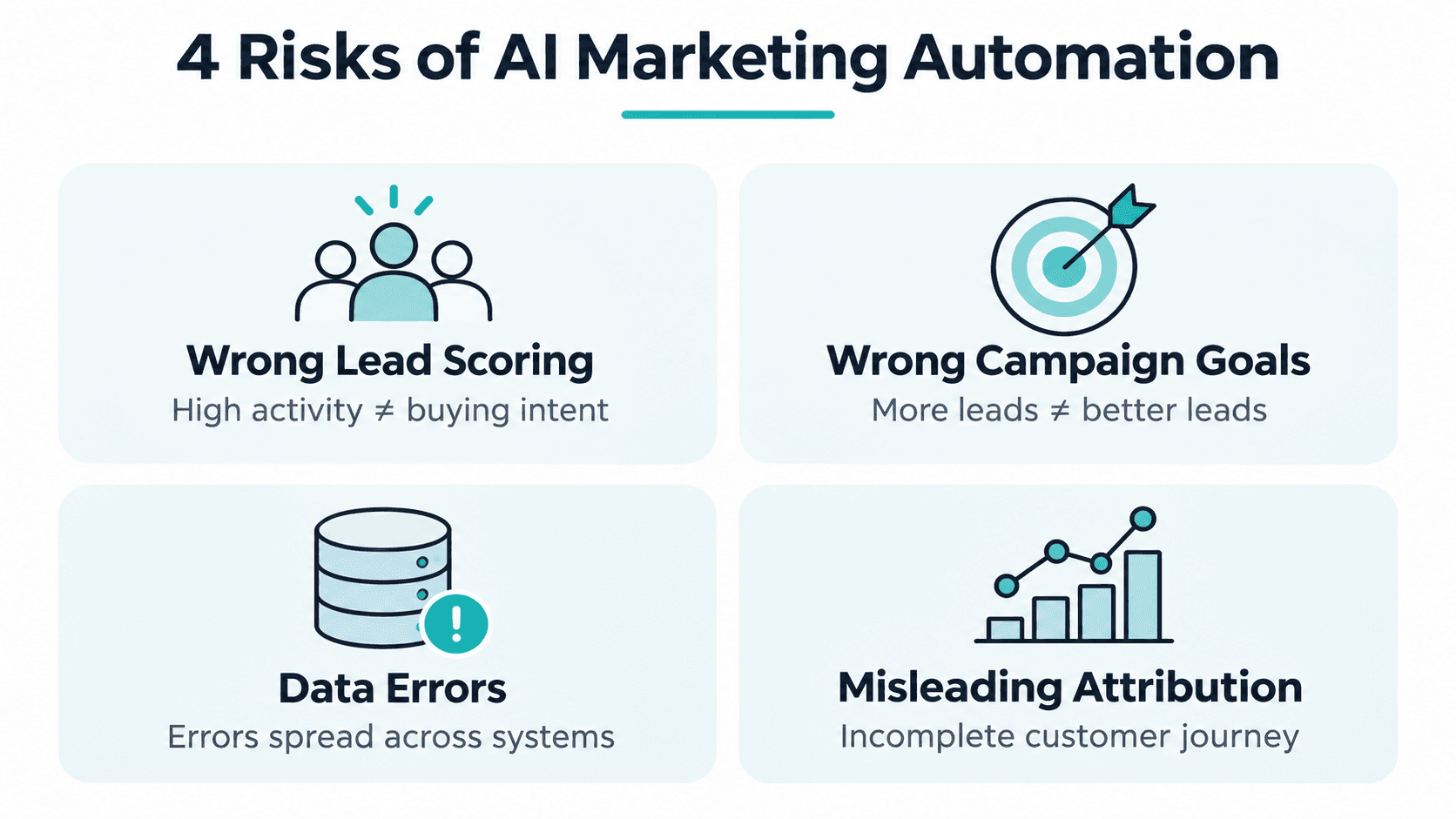
AI marketing automation can create problems when businesses automate workflows without understanding their limitations or measuring the right outcomes.
The main risks involve lead quality, campaign optimization, content relevance, data reliability, and excessive confidence in automated reporting.
1. Automated Lead Scoring Can Prioritize the Wrong Prospects
Lead scoring systems may evaluate actions such as website visits, email clicks, and content downloads.
These signals can indicate interest, but they do not always represent buying intent.
Individual scores can also miss how B2B purchases actually happen. Forrester's 2023 Buyers' Journey Survey found that 93% of B2B buyers took part in a buying group of two or more people, so one contact's engagement rarely reflects the whole buying decision.
If a business optimizes lead scoring entirely around engagement, it may generate more marketing-qualified leads without improving sales opportunities.
Example: When More Leads Don't Mean Better Results
Consider a hypothetical B2B company that changes its lead-scoring criteria to prioritize website activity.
| Metric | Before | After |
| Marketing-qualified leads | 100 | 150 |
| Leads accepted by sales | 40 | 30 |
| Sales acceptance rate | 40% | 20% |
The company generates 50% more marketing-qualified leads, but the number accepted by sales decreases. The automation appears successful when measured by lead volume, even though downstream results have worsened.
This is an illustrative example, not a real customer result.
How to avoid this: Measure sales acceptance rates, qualified opportunities, and conversions alongside lead volume.
2. Campaign Optimization Can Reinforce the Wrong Goals
Advertising platforms use automated systems to optimize campaigns toward selected objectives.
These systems can be effective, but their results depend on the objectives and conversion signals supplied.
For example, a campaign optimized for low-cost form submissions may generate many enquiries without attracting qualified prospects.
Google's lead generation playbook discusses the importance of robust measurement and offline conversion data when optimizing for lead quality.
How to avoid this: Define meaningful conversion events and, where supported, connect CRM outcomes such as qualified leads or completed sales to campaign measurement. In Google Ads, this is done with enhanced conversions for leads, which matches conversions recorded in your CRM back to the ad interactions that produced them.
3. Automated Workflows Can Spread Data Problems
Marketing workflows often connect several applications.
An enquiry may move from a website form into a CRM, trigger an email sequence, and appear in a reporting dashboard.
If the original information is incomplete, duplicated, or incorrectly mapped, automation can spread those errors across systems.
Data problems are the most common obstacle marketers report. In the same Salesforce State of Marketing research, 98% of marketers said they hit barriers to personalization, with data issues the most frequent cause.
How to avoid this: Monitor integration failures, review data quality, maintain logs, and establish procedures for correcting exceptions.
4. Attribution Models Can Create False Confidence
Marketing attribution models estimate how different interactions contribute to conversions.
Common approaches include last-click and data-driven attribution.
These models provide useful information, but they may not capture every influence on a customer's decision.
A buyer might discover a company through an article, discuss it with colleagues, visit the website several times, and eventually convert through an advertisement.
Not every influence will necessarily appear in the attribution report.
Google's Analytics attribution documentation explains how attribution settings and models work. It also notes that first-click, linear, time-decay, and position-based models are no longer available in Google Analytics 4, leaving data-driven and last-click attribution.
How to avoid this: Combine attribution reports with customer feedback, sales insights, experiments, and broader business performance.
AI Marketing Automation vs. Traditional Automation: What's the Difference?
Not every marketing process needs artificial intelligence.
Traditional automation is often suitable for predictable tasks that follow clearly defined rules. AI is useful when a workflow requires interpreting information, generating language, or identifying patterns.
| Factor | Traditional marketing automation | AI marketing automation |
| How it works | Follows predefined rules | Combines AI capabilities with workflow rules |
| Suitable information | Structured and predictable | Can also handle suitable unstructured information |
| Common tasks | Scheduling, CRM updates, reminders | Enquiry interpretation, content generation, analysis |
| Flexibility | Depends on predefined conditions | Can handle more variable inputs |
| Main limitation | Limited ability to interpret unexpected inputs | Outputs can be inaccurate or unreliable |
| Human oversight | Configuration and monitoring | Configuration, monitoring, and output validation |
For example, sending a welcome email after a newsletter signup does not require AI.
Interpreting a detailed customer enquiry and preparing a relevant response may benefit from AI.
Businesses should use the simplest reliable technology that solves the problem rather than introducing AI into every workflow.
Which Marketing Tasks Should Stay Human?
AI can support marketing decisions, but some activities require human judgment because they involve business context, customer relationships, or significant commercial consequences.
| Marketing activity | What to automate | What humans should review |
| Lead management | Capture, CRM updates, routing | Qualification criteria |
| Email marketing | Scheduling and triggered workflows | Messaging and communication frequency |
| Paid advertising | Routine optimization and reporting | Objectives, budgets, conversion quality |
| Content marketing | Drafting and scheduling assistance | Accuracy, originality, brand positioning |
| Reporting | Data collection and summaries | Interpretation and recommendations |
| Attribution | Tracking and reporting | Assumptions and strategic decisions |
| Customer communication | Routine follow-ups | Sensitive situations and exceptions |
Human oversight should be proportional to the risk and impact of the activity.
This matches established guidance. The US National Institute of Standards and Technology's AI Risk Management Framework and its Generative AI Profile identify over-reliance and automation bias as risks to manage, and McKinsey suggests human review for anything AI produces that goes directly to a customer.
The goal is not to manually repeat reliable automated work. It is to maintain accountability for decisions that require judgment.
How to Audit Your Existing Marketing Automation
Before investing in additional tools, businesses should evaluate whether their existing workflows are delivering the intended results.
A practical audit can be completed in six steps.
Step 1: Identify Your Automated Workflows
List the marketing activities currently handled by software.
Record the tools involved, the purpose of each workflow, and who is responsible for monitoring it.
Step 2: Define the Intended Outcome
Identify what each workflow is supposed to improve.
For example, lead-routing automation might aim to reduce response times or improve the handling of qualified enquiries.
Step 3: Review Data Quality
Check whether customer information is accurate and consistent across connected systems.
Look for duplicate records, missing information, incorrect assignments, and integration errors.
Step 4: Compare Activity With Business Results
Review both operational performance and business outcomes.
For example, compare lead volume with sales acceptance rates and qualified opportunities.
Step 5: Identify Where Human Review Is Necessary
Determine which activities can operate automatically and which require approval, exception handling, or periodic evaluation.
Step 6: Test Improvements Against a Baseline
Choose one workflow, record its current performance, and introduce a specific improvement.
Compare the results before expanding the changes.
The purpose of an automation audit is to improve outcomes, not simply increase the number of automated activities.
How Can Businesses Measure AI Marketing Automation ROI?
The return on investment from AI marketing automation depends on implementation costs and the measurable business value generated.
Potential benefits include reduced manual effort, faster response times, fewer errors, and improved conversion outcomes. However, time saved does not automatically equal money saved.
What Should Businesses Include in AI Marketing Automation Costs?
A realistic cost assessment should include:
• Initial workflow design and implementation
• CRM and marketing platform integrations
• Software subscriptions and AI usage
• Testing and employee training
• Ongoing maintenance and monitoring
• Human review and error correction
A basic financial ROI formula is:
ROI (%) = [(Financial benefits − Total costs) ÷ Total costs] × 100
For example, a business should estimate the financial value of time saved, measurable conversion improvements, and avoided costs, then compare those benefits against the total investment over a defined period.
A workflow that saves time but requires extensive correction may deliver less value than expected.
How Falcon Reality Approaches AI Marketing Automation
At Falcon Reality, we begin by understanding the business workflow before deciding which technology to use.
Not every process needs artificial intelligence. Predictable activities such as scheduled reminders, CRM updates, and structured data transfers can often be handled through traditional automation.
Other activities, such as interpreting customer enquiries, processing unstructured information, or generating content, may benefit from AI. Our work on Mizo illustrates this approach.
Instead of treating campaign planning, copywriting, visual creation, and scheduling as separate tasks, Mizo connects them into one workflow that can generate 30 days of campaign content from a single brief.
The broader principle is to identify where AI provides useful capabilities, where ordinary automation is sufficient, and where people should retain oversight.
Not Sure Which Marketing Workflows Need AI?
Some marketing processes work better with simple automation. Others may benefit from AI.
Falcon Reality helps businesses evaluate their workflows, identify practical automation opportunities, and implement solutions around their operational requirements.
Explore our AI services or book a consultation to discuss where automation could make a measurable difference.
Conclusion: Better Marketing Automation Requires Better Decisions
AI marketing automation can reduce manual work, improve response times, simplify campaign production, and make reporting more efficient. But faster execution does not guarantee better marketing outcomes.
A business can generate more leads without improving sales opportunities. It can publish more content without improving relevance. It can produce detailed reports without understanding what needs to change.
The solution is not to automate everything or avoid automation altogether.
It is to use the right technology for the right task, measure meaningful outcomes, and retain human judgment where business context matters. Effective AI marketing automation means automating the right work so marketing teams can spend more time making better decisions.