
 Maritime

Introduction
Commercial shipping teams process thousands of emails, documents, and operational updates every week, yet much of this information remains trapped across disconnected systems. As chartering decisions become increasingly time-sensitive, maritime AI solutions are emerging as a practical way to reduce manual work, surface critical information faster, and improve commercial decision-making.
In this article, we explore how maritime AI solutions are transforming chartering and commercial shipping operations, the real-world use cases driving adoption, and why AI for maritime operations is becoming a competitive advantage.
Why Chartering and Commercial Operations Are Becoming More Complex
Chartering Teams Are Drowning in Operational Communications
A single vessel fixture can generate hundreds of emails before the voyage is completed.
A typical commercial shipping team continuously exchanges information with:
- Shipbrokers
- Charterers
- Port agents
- Operators
- Bunker suppliers
- Terminal representatives
- Technical managers
- Internal stakeholders
Every communication contains critical operational information, including:
- Fixture recaps
- Voyage instructions
- Notice of Readiness (NOR) submissions
- Bunker nominations
- Cargo updates
- Demurrage calculations
- Charter party amendments
- Port documentation
The challenge is not the volume of emails. It is that critical information is buried inside thousands of unstructured conversations.
One commercial manager told us that finding the latest fixture recap can sometimes take longer than preparing the recap itself.
A chartering manager may spend more time searching for information than acting on it.
Data Scattered Across Multiple Systems
Information Exists Everywhere and Nowhere at the Same Time
Commercial decisions often require information from multiple sources:
| Information Needed | Usually Found In |
|---|---|
| Charter party clauses | PDF contracts |
| Voyage performance | Voyage management software |
| Previous negotiations | Email threads |
| Customer history | CRM systems or spreadsheets |
| Port instructions | Shared folders |
| Cost reports | ERP systems |
| Operational procedures | Individual employee knowledge |
According to a 2026 report by Lloyd's Register and OneOcean, shipping companies are producing more operational data than ever before, yet much of it remains fragmented, poorly structured, and underutilised, limiting its value for operational and commercial decision-making.
This creates a dangerous dependency on tribal knowledge.
When experienced employees leave the company, they often take years of operational context with them.
The result is:
- Slower decisions
- Repeated mistakes
- Increased onboarding time
- Operational bottlenecks
The Commercial Window to Make Decisions Is Shrinking
A vessel can become commercially unattractive within hours due to:
- Sudden port congestion
- Weather disruptions
- Canal restrictions
- Changing bunker prices
- New cargo opportunities
- Freight market movements
The difference between winning and losing a fixture is increasingly determined by how quickly teams can:
- Find information
- Assess risks
- Evaluate alternatives
- Make decisions
Decision speed has become a competitive advantage.
What Are Maritime AI Solutions for Chartering and Commercial Teams?
Maritime AI Solutions Are Becoming an Operational Intelligence Layer
Most shipping companies already possess enormous amounts of data, including:
- Emails
- Contracts
- Voyage reports
- Noon reports
- Invoices
- Operational procedures
- Historical fixtures
The problem is not a lack of information.
The challenge is that this information is often fragmented, unstructured, and difficult to access across multiple systems.
Maritime AI solutions act as an operational intelligence layer that sits across existing systems, enabling commercial teams to:
- Find information instantly
- Automate repetitive work
- Extract knowledge from documents
- Generate operational insights
- Support faster decision-making
Rather than replacing chartering professionals, AI is increasingly being used to augment human expertise by reducing administrative workloads and allowing teams to focus on higher-value commercial decisions.
Real-World Maritime AI Solution Use Cases in Commercial Shipping
1. Intelligent Email Management
AI systems can automatically:
- Categorize communications
- Extract operational information
- Generate summaries
- Route tasks to the correct teams
This significantly reduces administrative workload and improves response times.
Real-World Example: Norvic Shipping uses Sedna to manage high-volume operational email. By automatically tagging messages and centralizing collaboration in shared inboxes, the team reduced email admin and saved up to 8 hours per week, allowing operators to focus more on voyage optimization and customer service.
2. Document Processing and Extraction
Shipping companies process a wide range of documents, including:
- Invoices
- Bills of lading
- Charter parties
- Certificates
- Port documentation
AI-powered document processing can extract information automatically and integrate it into business systems.
Real-World Example: The Port of Rotterdam Authority reduced manual invoice processing effort by more than 70% using AI-powered document automation.
3. Commercial Knowledge Assistants
AI assistants can instantly retrieve information from:
- Historical voyages
- Contracts
- Operational procedures
- Commercial reports
Instead of searching across multiple systems, employees receive answers in seconds.
4. Voyage Performance Analysis
AI systems can analyze:
- Historical voyage performance
- Cost trends
- Customer patterns
- Route profitability
This enables better commercial decisions and more accurate forecasting.
Real-World Example: Carisbrooke Shipping reported fuel savings of 5-7% after implementing Wärtsilä's AI-powered Fleet Operations Solution, while Nautilus Labs has reported fuel reductions of up to 12% through AI-driven voyage optimization. These solutions analyze operational data, weather conditions, and voyage patterns to improve vessel performance and reduce costs.
5. Predictive Commercial Intelligence
AI can identify:
- Emerging market opportunities
- Customer trends
- Operational risks
- Potential bottlenecks
The result is faster, more informed commercial decision-making.
Real-World Example: Maersk Line used predictive analytics to reduce empty-container repositioning costs, predict potential engine failures, and optimize schedules and fuel consumption.
Benefits of Maritime AI Solutions for Commercial Shipping Operations
Faster Decision-Making
Teams spend less time searching for information and more time making informed commercial decisions.
Reduced Administrative Work
Manual processes such as email handling, document processing, and data entry can be automated, allowing teams to focus on higher-value activities.
Better Knowledge Management
Critical information becomes accessible across the organization instead of being stored in individual inboxes or relying on employee knowledge.
Improved Customer Responsiveness
Faster access to operational and commercial information enables quicker, more accurate responses to customers and partners.
Higher Productivity
Commercial professionals can spend more time on negotiations, customer relationships, and strategic decision-making instead of administrative tasks.
Lower Operational Costs
Automating repetitive processes improves operational efficiency and reduces administrative expenses.
Better Visibility
AI creates a single source of truth by connecting fragmented data across emails, documents, operational systems, and business applications.
How to Successfully Implement Maritime AI Solutions
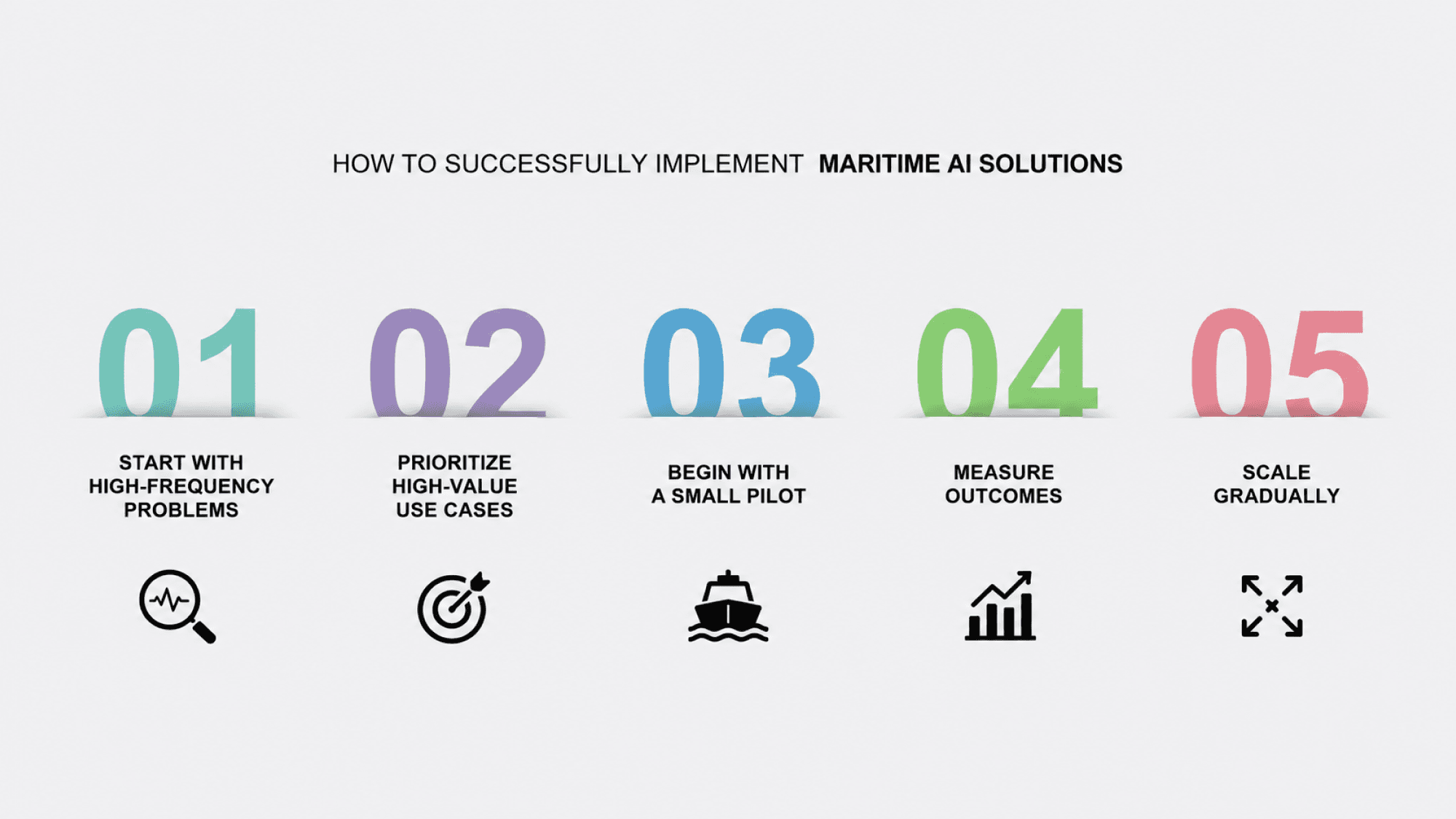
Start With High-Frequency Problems
The best AI initiatives usually begin with processes that:
- Consume significant time
- Are repetitive
- Have clear business impact
Examples include:
- Email processing
- Document extraction
- Knowledge search
Prioritize High-Value Use Cases
Ask:
- Which processes delay decisions?
- Which tasks frustrate employees?
- Which activities create bottlenecks?
Begin With a Small Pilot
Avoid attempting to transform the entire organization at once.
Successful companies often start with:
- One department
- One workflow
- One measurable problem
Measure Outcomes
Track metrics such as:
- Hours saved
- Response times
- Processing speed
- User adoption
- Revenue impact
Scale Gradually
Once value is demonstrated, AI can expand into:
- Chartering
- Operations
- Procurement
- Compliance
- Fleet management
Common Mistakes Companies Make When Adopting Maritime AI Solutions
Buying Technology Before Defining the Problem
Technology should solve business problems, not create new ones.
Trying to Automate Everything
Not every process needs AI.
Organizations should focus on high-impact use cases first.
Ignoring User Adoption
Technology fails when employees do not trust or use it.
Human adoption is often more difficult than technical implementation.
Using Generic AI Without Maritime Context
Shipping has unique workflows, terminology, and operational requirements.
Solutions that do not understand maritime operations often struggle to deliver meaningful results.
Failing to Measure ROI
Without clear metrics, organizations cannot determine whether initiatives are creating value.
Want to Learn More?
Implementing AI successfully requires more than choosing the right technology. Learn why many maritime AI projects fail and the practical steps shipping companies can take to achieve successful adoption in our guide: Why Maritime AI Projects Fail (and How to Avoid Them).
The Future of AI for Maritime Operations and Commercial Shipping Technology
The next phase of AI adoption in shipping is expected to focus on practical, workflow-driven applications rather than fully autonomous operations. Industry research suggests maritime AI is growing quickly, with the biggest impact coming from efficiency, safety, and better decision-making.
Areas likely to see significant growth include:
-
AI agents for chartering: Digital assistants that help commercial teams manage chartering workflows, screen opportunities, and coordinate post-fixture tasks.
-
Unified commercial knowledge platforms: Tools that give teams faster access to internal documents, procedures, and operational information.
-
Intelligent workflow automation: AI systems that reduce manual work by coordinating tasks across teams and systems.
-
Predictive commercial intelligence: AI that helps identify risks, bottlenecks, and opportunities earlier, especially in routing, compliance, and commercial planning.
-
Decision support systems: AI that recommends actions and highlights risks while humans retain final decision-making control.
The future of maritime AI is not about replacing maritime professionals. It is about helping them work faster, reduce manual effort, improve commercial visibility, and make better decisions in increasingly complex operating environments.
Conclusion
Chartering and commercial shipping operations are becoming increasingly data-intensive and operationally complex. Teams are expected to process more information, respond faster, and make better decisions while managing growing volumes of emails, documents, and operational data.
This is where a maritime AI solution is creating measurable value. From AI for chartering operations and voyage management to maritime workflow automation and predictive analytics in shipping, artificial intelligence is helping shipping companies improve productivity, reduce administrative effort, and gain operational intelligence.
The companies that will benefit most from AI in maritime operations will not necessarily be those investing the most in technology. They will be the organizations that focus on high-impact use cases, build stronger knowledge management capabilities, and use maritime data analytics to make faster and more informed commercial decisions.